
AI Agency vs In-House: How to Decide Who Builds Your AI
AI agency vs in-house team, compared on speed, skills, cost, risk and ownership, with a quick test for when hybrid makes sense.
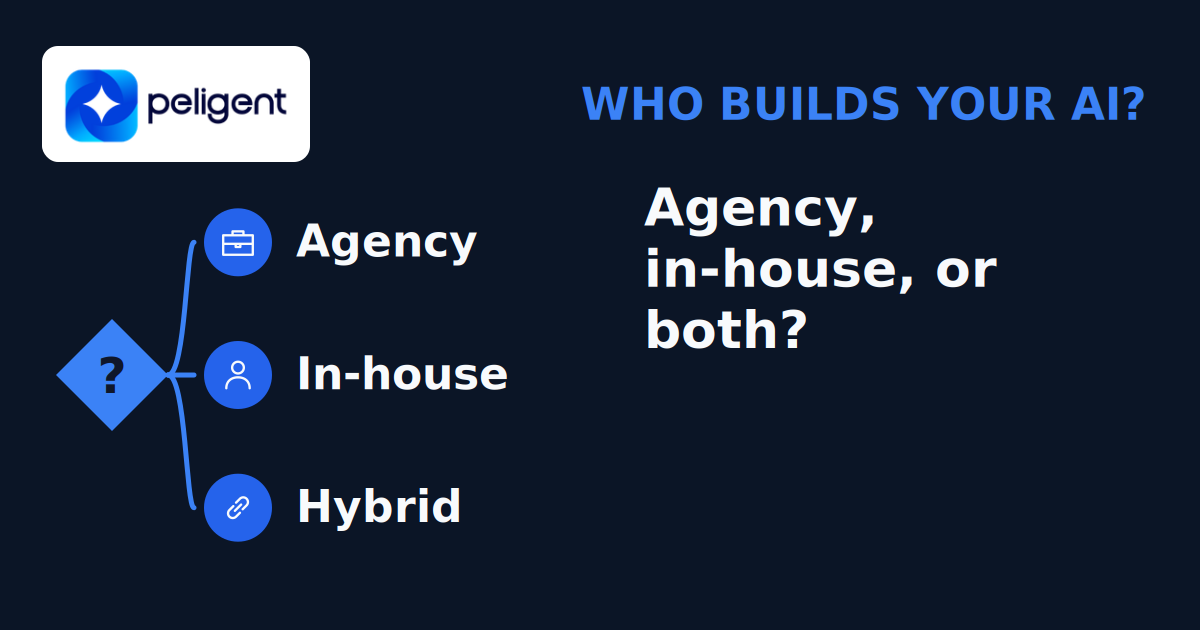
AI agency vs in-house: choose an agency for a defined project when your team lacks the skills or capacity to build it. Choose in-house when AI is central to your product and you have steady work, technical leadership and time to hire. Choose hybrid when you want an internal owner to set priorities while outside specialists handle the build.
Compare the same workflow, delivery requirements and operating period for each option. An agency is not automatically faster or cheaper. An existing internal team may already have the access and business knowledge needed. Whichever path you choose, settle data and account ownership, code licence terms and handover responsibilities in writing before work starts.
Key takeaways
- Compare actual team availability and skills, not agency or in-house labels.
- Include support, AI usage, staff time and handover in the cost comparison.
- Keep a business owner inside your company from the start, even if you outsource the build.
- A future handover needs your data and accounts, a clear code licence, documentation and agreed training.
What are your three options?
First check whether an existing tool can handle the job. A personal writing task may need only an AI subscription. A workflow connecting your inbox, CRM and approvals needs someone responsible for the whole process. Building a custom model is a separate decision from deciding who connects and runs your tools.
1. Hire an AI agency
An outside team scopes and builds agreed workflows. Ask who will actually do the work, what similar systems they can demonstrate and when they are available. Your staff still need to explain the process, provide access and review results. Outsourcing the build does not outsource accountability for the business outcome.
2. Build in-house
Your employees build and operate the system. For a small business, this could start with a technical operations owner supported by existing staff, rather than a research team. List the skills the work needs before writing a job description. A single hire may need help with integrations, testing, access controls or deployment.
3. Hybrid
An internal owner sets priorities and accepts the work; an outside team supplies specialist capacity. This can start on day one. Define who fixes failures, approves changes and maintains documentation so that shared responsibility does not become nobody's responsibility.
How do agency and in-house compare?
Use these questions to test the actual agency proposal and internal staffing plan.

- Speed: check agency availability against internal capacity, including any hiring. Both need data access, staff input and acceptance testing before launch.
- Skills: ask for the named project team and who covers each task. Compare that with your staff's skills and the gaps you would need to fill.
- Business context: an agency needs your input; an internal team needs documented processes too. Neither can fix an unclear workflow by adding AI.
- Changing priorities: check agency exit terms and change-request rules. With employees, consider which other work they could take on if a project stops.
- Ownership and licences: agree who controls the data and accounts, what rights the code licence grants, and what a future handover includes. Check third-party licences separately.
What costs should you compare?
Use the same scope and operating period for both estimates. Salary alone and a build-only quote are not comparable.
- In-house: recruiting, salary and benefits, management time, training, tools, hosting and cover when someone leaves or is unavailable.
- Agency: discovery or audit work, the build, change requests, ongoing support, internal staff time and any exit or handover work.
- Both: AI usage, data cleanup, access reviews, testing, monitoring and maintenance as connected tools change.
Ask what is excluded and who pays the model provider. A fixed scope limits the agreed work; it does not make future operating costs disappear. Estimate the effect of more workflows, users and daily requests before comparing options.
Our pricing page explains fixed-price audits and fixed-scope builds without publishing a rate card. Request a scope for your own workflow rather than using a generic salary or project price as a decision rule.
Does research show agencies are more successful?
A preliminary July 2025 report from Project NANDA, The GenAI Divide: State of AI in Business 2025 (public PDF mirror), reports deployment for about 67% of external partnerships using customized, learning-capable tools, versus about 33% of internal builds. Its methodology includes interviews with 52 organizations, surveys of 153 senior leaders and review of over 300 public initiatives, conducted from January to June 2025.
Those are self-reported findings, not an agency success guarantee. The report says success definitions varied, the comparison reflects its interview sample and correlation does not prove causation. It does not give precise initiative totals for each group, and hybrid had insufficient data. External partnerships also include vendor collaboration, not only hiring an agency. The figures do not establish a small-business benchmark.
MIT's official NANDA page provides report access through a form. The linked PDF is hosted by MLQ, not MIT. Use this preliminary evidence to frame questions, not to predict your own result.
When is an agency a better fit?
- You have a defined project and a skills gap. Check that the proposed team can cover it.
- Your workload comes in bursts. A scoped engagement may fit better than an ongoing hire.
- You need help assessing feasibility. An audit can test the problem and data before a larger commitment.
Examples include a custom business portal that brings leads, clients and reports together, or AI workflow automation that connects tasks across existing tools. Ask for a demonstration of a comparable working system, not just a proposed design.
When should you build in-house?
- AI is central to your product. Retaining technical knowledge may matter more than a quick first build.
- You have continuous work. There is enough development and maintenance to support a dedicated role, plus someone able to manage it.
- You already have a capable team. Give its capacity and delivery plan the same scrutiny as an agency proposal.
- Your data rules constrain access. Check the permitted setup before choosing a staffing model. Internal delivery alone does not settle how outside AI providers process data.
Plan backup cover. If only one person understands the system, absence or turnover can leave daily work unsupported.
How do you keep a future handover possible?
Agency first and in-house later can work when you own your data and accounts and the code licence supports the responsibilities your team will take on. Peligent retains code ownership and grants an ongoing licence to use it. Get the licence and handover terms in writing before signing, including these points:
- Code licence: the scope of ongoing use, any source access or modification rights, and whether an incoming team may maintain or host the software. List third-party dependencies and their licences. Do not assume a repository or code ownership transfers with the project.
- Data: access to your business data, usable exports and a tested way to recover it.
- Accounts: company-controlled admin logins and a list of agency access you can remove.
- AI usage: who holds the model accounts, pays usage charges and controls billing. With Peligent, usage runs on your own accounts at provider cost.
- Handover: setup instructions, tests, monitoring, recovery steps and training for the person taking over.
Before ending support, have the incoming operator test the tasks they are permitted and expected to handle, including recovery from a simulated failure. If they will modify code, confirm that the licence permits it and test that process too. Agree how licensed components and connections will keep running after the handover.

How should you make the decision?
| Your situation | Option to assess first |
|---|---|
| Defined project, limited internal capacity | Agency |
| Unclear problem or uncertain data quality | Audit before choosing a build |
| AI is core to the product, with continuous work | In-house |
| Internal owner, occasional specialist needs | Hybrid |
| No clear data, account, licence or handover terms | Resolve the agreement first |
Give each option the same short brief: the workflow, systems involved, data access, approvals and a measurable acceptance test. Compare named owners, start dates, exclusions and support terms.
For example, if AI drafts inbox replies, decide who reviews them, which mistakes block launch and how staff return to manual handling. Measure time spent reviewing as well as time saved drafting. Include staff training and rollout in the plan. Our guide to AI implementation for small business covers planning the first project.
How does Peligent structure the work?
Peligent is an AI implementation agency in Toronto serving teams in Canada and the US. Our process is Audit, Design, Deliver, with an optional run plan:
- Audit, 1 to 2 weeks: map workflows and rank possible improvements. You keep the plan.
- Design and deliver, 2 to 6 weeks: build the agreed scope around your team's work and existing tools.
- Run plan: optional monthly support, cancel anytime. Agree responsibilities if your own team takes over.
You own your data and your accounts. We license the code to you. Peligent retains code ownership and grants an ongoing licence to use it; your logins and AI model accounts stay yours, with model usage billed at provider cost and no markup. A person approves important actions. In the agent fleet we built, 13 AI agents and 26 automations handle scheduled work, with important actions waiting for a person's approval. That is one implementation, not a forecast for yours. For the portal route, see what a custom business portal is and when you need one.
Frequently asked questions
Is it cheaper to hire an AI agency or build in-house?
Neither is always cheaper. Compare an actual scoped quote with the full cost of internal delivery over the same period, including support, staff time and maintenance. Continuous work can make a hire worth considering; occasional projects can suit an agency.
Can a small business build AI in-house without engineers?
Some standalone tasks need only a ready-made tool. Connecting business systems, handling permissions and supporting failures requires technical skills. Check whether your team has those skills before committing to a custom workflow.
What should I own when an agency builds AI for me?
Keep ownership of your data and accounts, and get the code licence and handover terms in writing. Confirm what the incoming team may access, run or modify, and list third-party licences separately. Test the agreed access and data export before the engagement ends.
Is my data safe with an AI agency?
Neither staffing model guarantees safety. Ask what data each provider receives, where it is stored, who can access it and how access is removed. Have the appropriate internal reviewer or counsel check requirements for sensitive or regulated data.
When should we move from an agency to in-house?
Consider it when ongoing work justifies a role, someone can manage it and the incoming owner can operate the system. Complete a tested handover before ending outside support.
Bring one workflow you want to improve. Book a free call to discuss the scope and next step. The call is 30 minutes, with no slides.
Written by
Wana DaliriAI content writer at Peligent. Covering WordPress, WooCommerce, and AI for e-commerce.
Get new guides by email
Practical AI for shops, agencies and firms. No spam.