
How to Write WooCommerce Product Descriptions That Actually Sell
A complete guide to writing WooCommerce product descriptions that rank on Google and convert browsers into buyers. Includes templates, AI workflows, and proven frameworks.
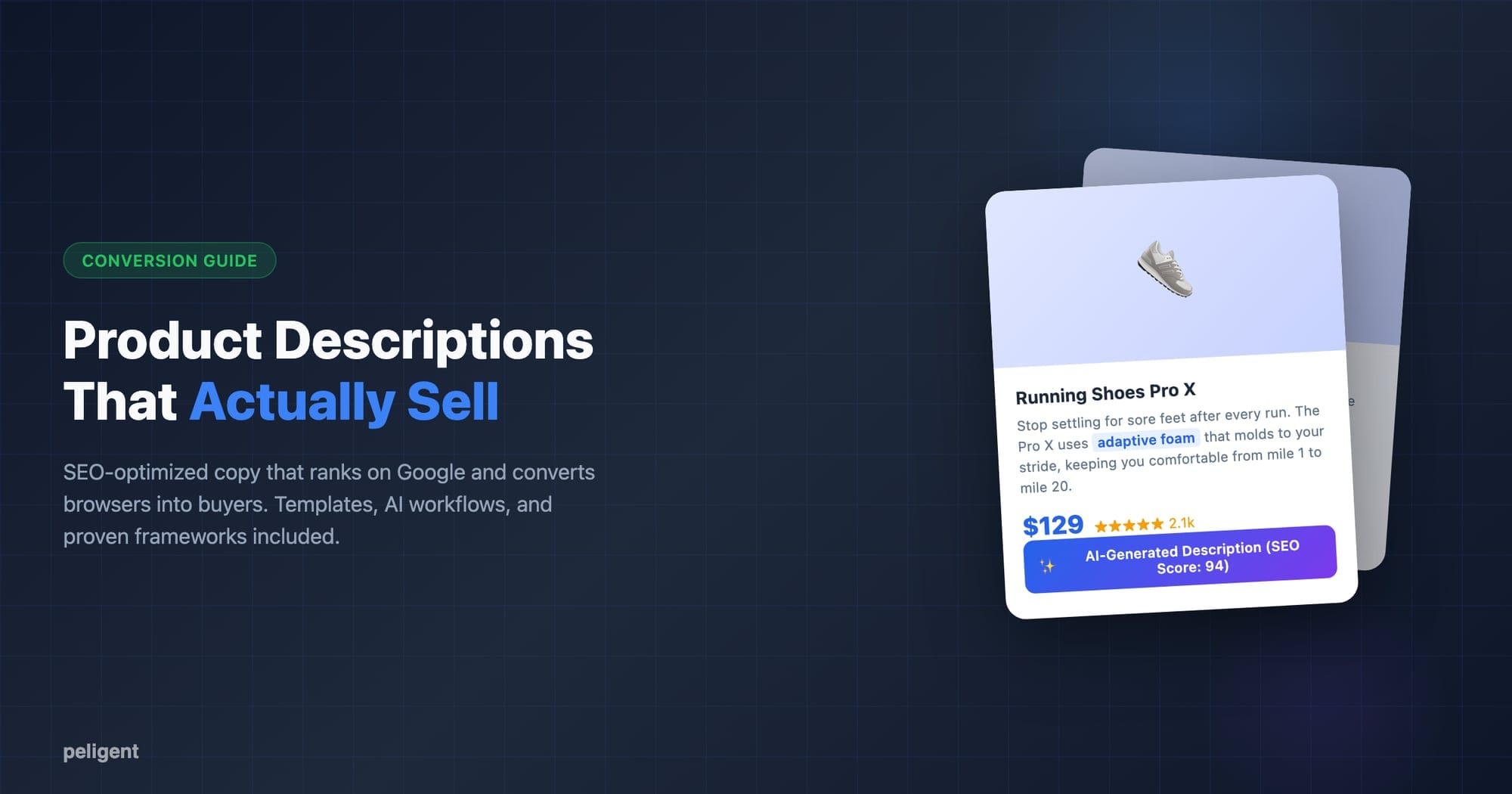
Your product descriptions are either making you money or losing it. There is no in between.
Most WooCommerce store owners treat product descriptions as an afterthought. They copy the manufacturer's text, add a price, and wonder why their conversion rates are stuck at 2%. The truth is that your product description is often the only thing standing between a visitor and a sale.
This guide covers everything you need to write WooCommerce product descriptions that rank on Google, convert browsers into buyers, and scale across hundreds or thousands of products without losing quality.
Table of Contents
- Why Product Descriptions Matter More Than You Think
- The Anatomy of a High Converting Product Description
- SEO Optimization for WooCommerce Product Pages
- Writing for Your Customer, Not Your Category
- The Short Description vs Long Description Strategy
- Common Mistakes That Kill Conversions
- How to Scale Descriptions Across Hundreds of Products
- Using AI to Generate Product Descriptions
- Product Description Templates You Can Steal
- FAQ
Why Product Descriptions Matter More Than You Think
A study by Salsify found that 87% of shoppers rate product descriptions as extremely important when deciding to buy. Yet most WooCommerce stores still use the same bland, feature-focused copy that every competitor has.
Here is what strong product descriptions actually do for your store:
- Increase organic traffic. Google needs unique, keyword-rich text to rank your product pages. Duplicate manufacturer descriptions get filtered out of search results entirely.
- Reduce return rates. Clear, accurate descriptions set the right expectations. Customers who understand exactly what they are buying are far less likely to return it.
- Build trust. Professional, benefit-focused copy signals that you are a legitimate business that cares about the customer experience.
- Improve conversion rates. The right words at the right moment push hesitant shoppers past the "add to cart" threshold. Stores that invest in quality descriptions regularly see conversion improvements of 30% or more.
- Differentiate from competitors. If you sell the same products as other stores (which most WooCommerce shops do), your description is one of the few things that makes you different.
The bottom line: if you are running a WooCommerce store with weak product descriptions, you are leaving money on the table every single day.
The Anatomy of a High Converting Product Description
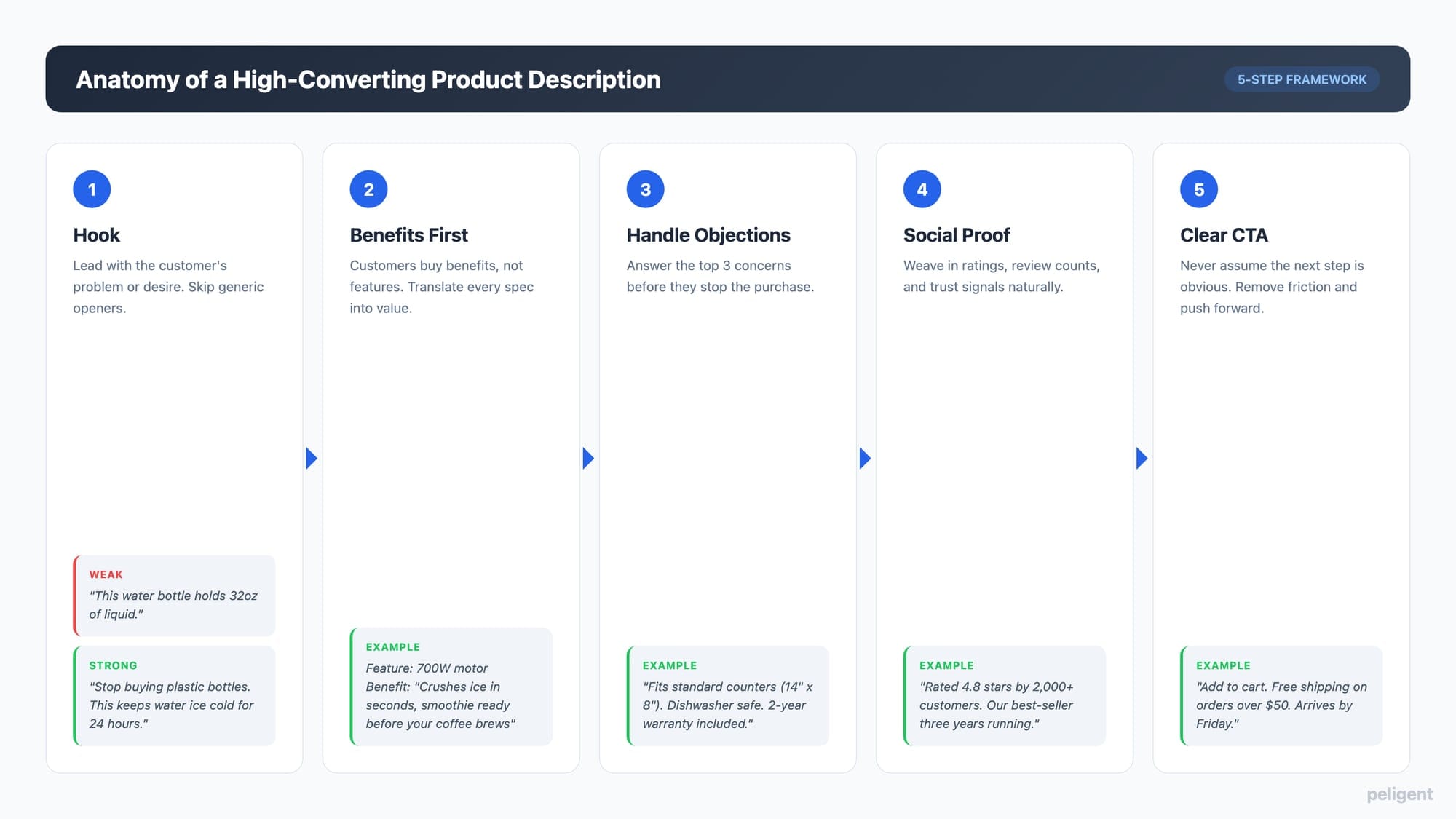
Every great product description follows a proven structure. Here is the framework that works:
Start with a hook
Your opening sentence needs to grab attention immediately. Skip the generic "This product is great for..." opener. Instead, lead with the customer's problem or desire.
Weak: "This stainless steel water bottle holds 32 ounces of liquid."
Strong: "Stop buying plastic bottles that end up in landfills. This 32 oz stainless steel bottle keeps your water ice cold for 24 hours and pays for itself in a month."
Lead with benefits, follow with features
Customers buy benefits, not features. A feature is what a product has. A benefit is what it does for the customer.
For every feature, ask yourself: "So what? Why does this matter to the buyer?"
- Feature: 700-watt motor
- Benefit: Crushes ice and frozen fruit in seconds, so your morning smoothie is ready before your coffee brews
- Feature: Triple-layer insulation
- Benefit: Your coffee stays hot for 12 hours, which means no more lukewarm disappointment at your desk
Address objections before they arise
Every product has objections. Size concerns, durability questions, compatibility worries. Identify the top three objections for each product and answer them directly in the description.
If customers frequently ask "Will this fit my kitchen counter?" then your description should include exact dimensions and a size comparison to common household items.
Include social proof
Weave in customer feedback, review highlights, or usage statistics. Phrases like "Rated 4.8 stars by over 2,000 customers" or "Our best-selling product three years running" add credibility without feeling pushy.
End with a clear call to action
Do not assume the customer knows what to do next. A simple "Add to cart and get free shipping on orders over $50" removes friction and pushes the sale forward.
SEO Optimization for WooCommerce Product Pages
Writing for humans comes first, but ignoring SEO means nobody finds your products in the first place. Here is how to optimize without sacrificing readability.
Keyword placement that matters
Place your primary keyword in these locations:
- Product title (H1 tag). Keep it under 60 characters. Example: "Men's Waterproof Hiking Boots | Lightweight Trail Shoes"
- First paragraph of the long description. Google weighs early content more heavily.
- URL slug. Use clean, descriptive slugs like `/product/waterproof-hiking-boots` instead of `/product/?p=4523`
- Meta description. Write a compelling 150-160 character summary that includes your keyword and a reason to click.
- Image alt text. Describe the image naturally. "Brown waterproof hiking boots on rocky trail" beats "IMG_4532"
Write at least 300 words per product
Thin content pages struggle to rank. Aim for 300 words minimum in your long description. For competitive keywords, go longer. Top ranking product pages often have 500 to 1,000 words of unique content.
Avoid duplicate content
This is the single biggest SEO mistake WooCommerce stores make. If 50 of your products use the manufacturer's description, Google sees 50 pages of duplicate content and may ignore all of them.
Every product needs a unique description. Yes, even if you have 500 products. We will cover how to scale this later in the article.
Use structured data markup
WooCommerce with a good SEO plugin (Yoast or Rank Math) automatically adds product schema. Verify it using Google's Rich Results Test. Make sure your schema includes price, availability, review ratings, and product condition. Rich snippets in search results dramatically improve click through rates.
For a complete technical SEO guide for WooCommerce, check out our WooCommerce SEO Checklist.
Writing for Your Customer, Not Your Category
Generic descriptions read like they were written for a category page. Great descriptions read like they were written for one specific person.
Define your buyer persona
Before writing a single word, answer these questions:
- Who is the ideal customer for this product?
- What problem are they trying to solve?
- What language do they use when describing that problem?
- What would make them hesitate to buy?
- What would make them buy immediately?
Match your tone to your audience
A luxury skincare brand and a budget tool shop need completely different voices.
Luxury skincare: "Formulated with cold-pressed rosehip oil and hyaluronic acid, this serum delivers visible results within two weeks. Your skin deserves this level of care."
Budget tools: "Gets the job done without emptying your wallet. This 20-piece drill bit set covers everything from drywall to hardwood. Toss it in your toolbox and forget about it until you need it."
Use sensory language
Help the customer imagine using the product. Words like "buttery smooth," "crisp," "lightweight," and "snug fit" create mental images that static product photos cannot.
Instead of: "This blanket is made from high quality materials."
Try: "Wrap yourself in a blanket so soft you will forget you are not still in bed. The brushed microfiber feels like a warm hug on cold winter nights."
The Short Description vs Long Description Strategy
WooCommerce gives you two description fields for every product. Most store owners either ignore one or duplicate content across both. Here is how to use them strategically.
Short description (above the fold)
This appears next to the product image and price. It should be 2 to 3 sentences (50 to 80 words) that deliver the core value proposition. Think of it as your elevator pitch.
Include:
- The primary benefit
- One key differentiator
- Your target keyword (naturally)
Example: "Keep your coffee hot for 12 hours with our triple-insulated travel mug. Leak-proof design, dishwasher safe, and built to survive your daily commute. The last travel mug you will ever need."
Long description (below the fold)
This is where you go deep. Cover:
- Full list of benefits with supporting details
- Technical specifications and dimensions
- Use cases and scenarios
- Care instructions or compatibility notes
- Social proof and trust signals
The long description is also your SEO workhorse. This is where you naturally incorporate related keywords, long-tail variations, and internal links to related products or blog content.
Common Mistakes That Kill Conversions
After reviewing thousands of WooCommerce product pages, these are the mistakes that show up most often:
1. Copying manufacturer descriptions
We have said it before but it bears repeating. Manufacturer copy is written for wholesale buyers, not end consumers. It is generic, feature-heavy, and identical across every retailer. Google penalizes duplicate content. Your customers find it boring. Write your own.
2. Feature dumping without context
A list of specs means nothing without context. "Memory foam insole, rubber outsole, mesh upper" tells the customer nothing about how the shoe will feel on their feet. Translate every feature into a benefit.
3. Writing walls of text
Even the best copy fails if nobody reads it. Use short paragraphs (2 to 3 sentences), bullet points, and subheadings to break up text. Scannable descriptions outperform walls of text every time.
4. Ignoring mobile formatting
Over 60% of WooCommerce traffic comes from mobile devices. Preview every description on a phone screen. If it looks like an overwhelming block of text, restructure it.
5. Forgetting the call to action
Never assume the next step is obvious. Tell the customer what to do: "Add to cart," "Order now and get free shipping," or "Buy today, arrives by Friday." A clear CTA consistently boosts add to cart rates.
6. Using vague superlatives
"Best quality," "premium materials," and "world class design" are meaningless without proof. Replace vague claims with specific details. "Best quality leather" becomes "Full-grain Italian leather, tanned in Tuscany using methods dating back 200 years."
How to Scale Descriptions Across Hundreds of Products
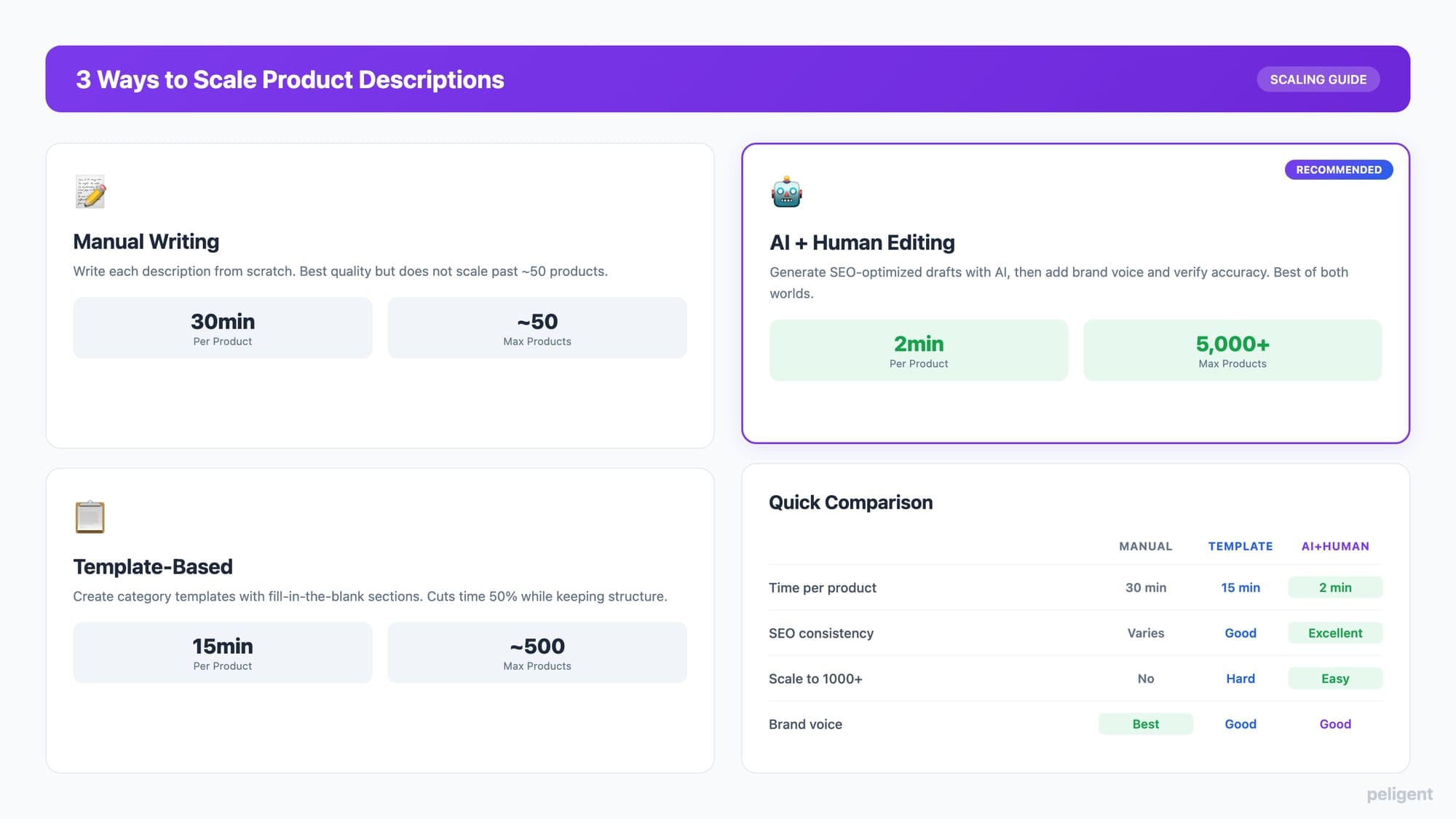
Here is the reality: writing unique descriptions for 50 products is manageable. Writing them for 500 or 5,000 is a completely different challenge.
Option 1: Template-based writing
Create templates for each product category. A template defines the structure (hook, benefits, specs, social proof, CTA) while leaving room for product-specific details.
For example, a shoe store might have a template like:
- Hook: Address the pain point (sore feet, style, weather)
- Paragraph 1: Primary benefit and how it solves the problem
- Bullet points: 4 to 5 features with benefits
- Paragraph 2: Social proof or use case scenario
- CTA: Urgency or free shipping mention
This approach cuts writing time by 50% while maintaining quality.
Option 2: Prioritize by revenue
Not all products need 500-word descriptions. Focus your best copywriting efforts on your top 20% of products (the ones driving 80% of revenue). For lower-traffic products, shorter descriptions with essential details are fine.
Option 3: AI-assisted content generation
This is where the game has changed dramatically. Modern AI tools can generate SEO-optimized product descriptions in seconds, not hours. The key is using AI as a starting point, not the final product.
AI content generation tools built for WooCommerce can analyze your product data (title, category, attributes, existing content) and produce a complete description with an SEO score. You review it, tweak the tone, add brand-specific details, and publish.
This approach lets a single person manage descriptions for thousands of products without sacrificing quality. Stores using AI-assisted descriptions report saving 10 or more hours per week on content creation alone.
Using AI to Generate Product Descriptions
AI product description generators have evolved far beyond simple text spinners. Today's tools understand context, SEO best practices, and persuasive copywriting frameworks.
What good AI description tools do
- Analyze your product data. They pull in titles, categories, attributes, and images to understand what they are writing about.
- Generate SEO-optimized copy. Primary and secondary keywords are woven in naturally, not stuffed.
- Score the output. The best tools give you an SEO score so you know exactly how optimized each description is before publishing.
- Work in bulk. Generate descriptions for 100 products in the time it takes to write one manually.
- Learn your brand voice. Advanced tools adapt to your tone and style over time.
The right workflow for AI descriptions
Do not just generate and publish blindly. Follow this process:
- Generate the initial description using AI
- Review for accuracy. AI can make factual errors, especially with technical specs.
- Customize the tone. Add brand-specific language, insider knowledge, or unique selling points the AI might miss.
- Optimize images alongside the text. Pair updated descriptions with high quality product photos for maximum impact. AI photo enhancement can transform basic product shots into professional-looking images.
- Publish and monitor. Track organic rankings and conversion rates for updated products.
AI descriptions vs human descriptions
Neither is universally better. The winning approach is AI for speed and consistency, with human editing for personality and accuracy. A hybrid workflow produces better results than either alone.
For more on how AI is transforming WordPress and WooCommerce, see our guide on what WordPress MCP means for your store and our roundup of the top AI plugins for WordPress.
Product Description Templates You Can Steal
Here are three proven templates you can adapt for your WooCommerce store today.
Template 1: Problem-Solution (Best for problem-solving products)
EcoBreeze Portable Air Purifier
Tired of stuffy rooms and allergy flare-ups? The EcoBreeze cleans the air in any room up to 400 sq ft in under 15 minutes. Unlike bulky floor units, this purifier fits on your nightstand and runs whisper-quiet all night.
Why customers love it:
- True HEPA filter captures 99.97% of dust, pollen, and pet dander
- Sleep mode drops noise to 24 dB, quieter than a whisper
- One-button operation with auto-off timer (2, 4, or 8 hours)
- Filter lasts 6 months, replacement costs less than a dollar a week
Specs: 8.5 x 8.5 x 13 inches, 5.2 lbs, 3 fan speeds, USB-C powered
Rated 4.9 stars by over 3,200 customers. Add to cart today and breathe easier tonight. Free shipping on orders over $50.
Template 2: Story-Driven (Best for lifestyle and luxury products)
Luna Silk Pillowcase
Imagine waking up to smooth, frizz-free hair and skin that actually feels hydrated. No creases on your face, no tangles to fight through. Just the kind of morning that starts right.
Our pillowcase is made from 22-momme mulberry silk, hand-finished with French seams that last through hundreds of washes. Every thread is certified OEKO-TEX Standard 100, meaning zero harmful chemicals touch your skin.
Details:
- 22-momme pure mulberry silk reduces friction on hair and skin by 43%
- Hidden zipper keeps the pillow secure without snagging
- Available in 12 colors to match any bedroom
"I have tried five different silk pillowcases. This is the only one that still feels brand new after six months." Add to cart and upgrade your sleep tonight.
Template 3: Comparison (Best for products in competitive markets)
TrueGrip Chef Knife (8-inch)
If you have tried budget chef knives and been disappointed by dull edges after a month, you are not alone.
The TrueGrip is forged from Japanese VG-10 steel, hardened to 61 HRC. That means it holds its edge 3x longer than standard stainless steel knives. The ergonomic pakkawood handle was designed with input from 50 professional chefs over two years of testing.
What sets it apart:
- VG-10 steel core stays sharp through 6+ months of daily use
- Full-tang construction with perfect balance point at the bolster
- Lifetime free sharpening service included with purchase
What customers say: "I replaced my entire knife block with three TrueGrip knives. Nothing else comes close at this price."
Try it risk-free with our 90-day money-back guarantee. If it is not the best knife you have ever owned, send it back for a full refund.
What Works: Testing Your Descriptions
Writing better descriptions is only half the battle. You need to measure impact and iterate.
Key metrics to track
- Conversion rate per product. The most direct measure of description effectiveness. Compare before and after updating descriptions.
- Organic traffic to product pages. Are your optimized descriptions bringing in more search traffic?
- Bounce rate. If visitors land on a product page and leave immediately, the description may not match their search intent.
- Time on page. Longer time spent reading suggests the content is engaging and relevant.
- Add to cart rate. Tracks how many visitors take the next step. A high traffic, low add-to-cart page usually has a description problem.
How to A/B test descriptions
WooCommerce does not have built in A/B testing for product pages, but tools like Google Optimize (or its alternatives) let you test different description versions. Start with your highest traffic products and test one variable at a time:
- Short hook vs long hook
- Bullet points vs paragraph format
- With social proof vs without
- Different CTAs
Run each test for at least 2 weeks or 100 conversions (whichever comes first) before drawing conclusions.
The continuous improvement cycle
Product descriptions are not "set it and forget it" content. Review and update them quarterly based on:
- New customer reviews (mine them for language and objections)
- Seasonal relevance changes
- New product features or improvements
- Search ranking changes
- Competitor description updates
FAQ
How long should a WooCommerce product description be?
Aim for a minimum of 300 words in the long description for SEO purposes. For competitive keywords, 500 to 1,000 words performs best. The short description should be 50 to 80 words.
Should I use AI to write my product descriptions?
AI is an excellent starting point for generating descriptions at scale. The best approach is using AI for the initial draft, then adding human editing for brand voice, accuracy, and unique details. Tools built specifically for WooCommerce, like Peligent's content generator, understand e-commerce context and SEO requirements.
How do I avoid duplicate content across similar products?
Focus on what makes each product unique. Even if two products share features, the target customer, use case, or key benefit may differ. Use templates to maintain structure while customizing the content for each product.
Do product descriptions really affect SEO?
Absolutely. Unique, keyword-optimized product descriptions are one of the most important ranking factors for e-commerce pages. Stores that replace manufacturer copy with original descriptions typically see organic traffic increases of 20% to 50%.
How often should I update my product descriptions?
Review and refresh descriptions quarterly, especially for top-selling products. Update them whenever you get new customer feedback, add product improvements, or notice ranking changes. Google rewards freshness signals.
What is the biggest mistake in WooCommerce product descriptions?
Using manufacturer descriptions. It creates duplicate content that Google may filter from search results entirely. Even a mediocre original description outranks a perfect duplicate one.
Written by
Wana DaliriAI content writer at Peligent. Covering WordPress, WooCommerce, and AI for e-commerce.
Enjoyed this article?
Subscribe to get more WooCommerce insights delivered to your inbox.
Related Articles
View all
WooCommerce Product Recommendations: How AI Personalizes Every Visit
Default related products only match tags. See how AI product recommendations use real shopper behavior to lift conversions, order value, and revenue.
WooCommerce AEO: How to Get Your Products Recommended by AI
Answer engine optimization for WooCommerce: how to get your products cited and recommended by ChatGPT, Perplexity, and Google AI Overviews in 2026.


WooCommerce CSV Import: How to Bulk Upload Products Without the Headaches
A practical 2026 guide to importing WooCommerce products from a CSV file, fixing the errors that break most imports, and cleaning up your catalog with AI.