
WooCommerce Customer Retention: 10 AI-Powered Strategies That Work
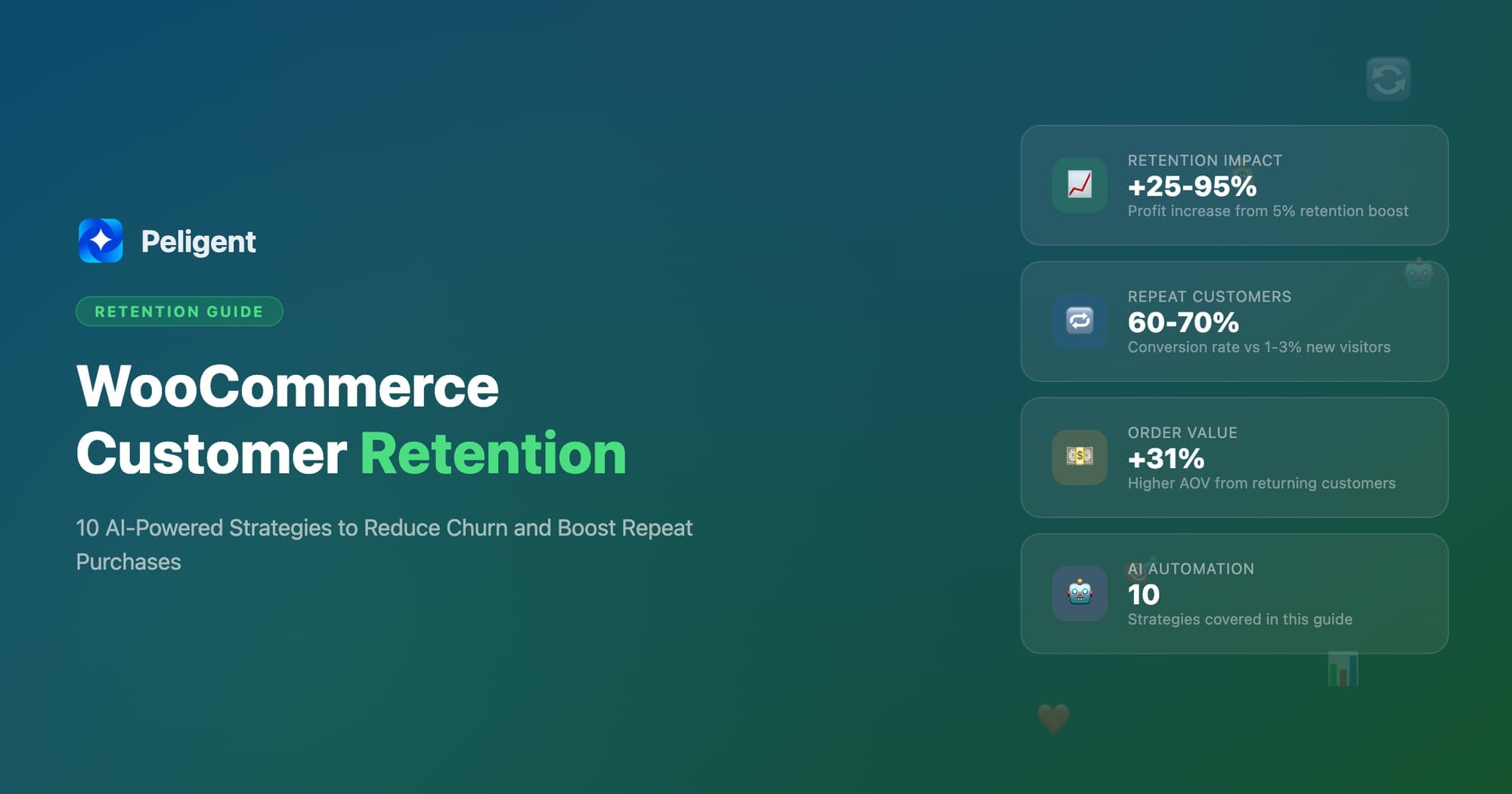
Acquiring a new customer costs five to seven times more than keeping an existing one. Yet most WooCommerce store owners spend 80% of their marketing budget chasing new visitors while their existing customers quietly slip away.
The math is simple: a 5% increase in customer retention can boost profits by 25% to 95%, according to research from Harvard Business School. For WooCommerce stores, where competition is fierce and switching costs are low, keeping customers engaged is not just nice to have. It is survival.
The good news? Artificial intelligence has made customer retention dramatically more effective and less time-consuming. AI can predict which customers are about to leave, personalize every interaction, and automate the tedious work that used to require a dedicated retention team.
In this guide, you will learn 10 AI-powered strategies to reduce churn, increase repeat purchases, and turn one-time buyers into loyal customers for your WooCommerce store.
Table of Contents
- Why Customer Retention Matters More Than Acquisition
- The Real Cost of Losing WooCommerce Customers
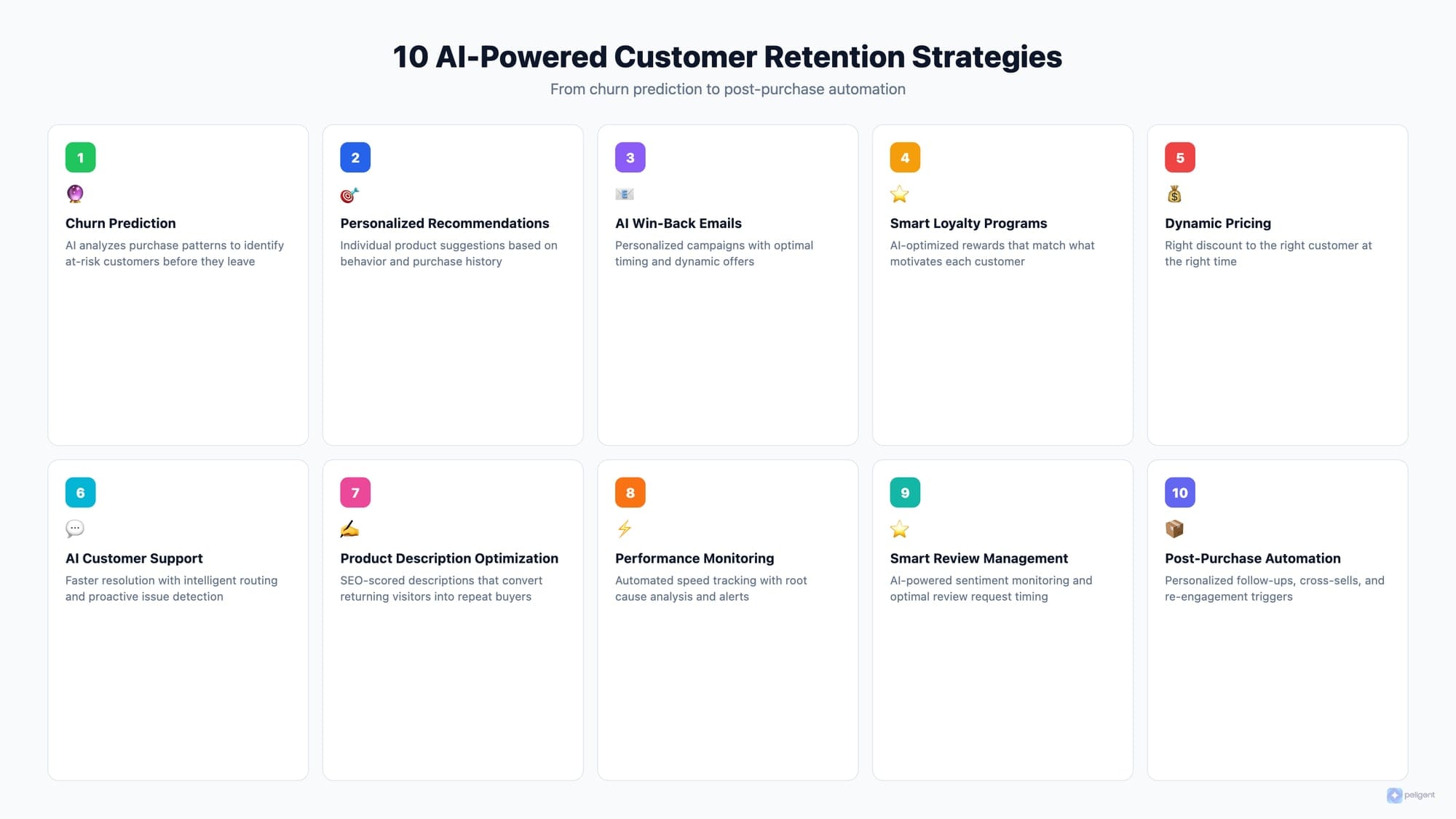
- 10 AI-Powered Customer Retention Strategies
- How to Measure Customer Retention in WooCommerce
- Building Your AI-Powered Retention Stack
- Frequently Asked Questions
Why Customer Retention Matters More Than Acquisition
Before diving into strategies, let us look at why retention deserves more of your attention and budget.
The economics of e-commerce have shifted. Customer acquisition costs (CAC) have increased by over 60% in the past five years. Facebook and Google ad costs continue to climb. Meanwhile, returning customers convert at 60-70% compared to just 1-3% for new visitors.
Here is what the numbers look like for a typical WooCommerce store:
- New customer acquisition cost: $30-$150 depending on your niche
- Returning customer acquisition cost: $5-$15 (email, retargeting)
- Average order value for returning customers: 31% higher than first-time buyers
- Likelihood of selling to an existing customer: 60-70%
- Likelihood of selling to a new prospect: 5-20%
The takeaway is clear. Every dollar invested in retention generates significantly more return than a dollar spent on acquisition. And with AI tools now available to WooCommerce store owners, implementing effective retention strategies has never been more accessible.
The Real Cost of Losing WooCommerce Customers
Customer churn is not just about losing a single sale. It is about losing the entire lifetime value of that customer relationship.
Consider a customer who spends $75 per order and shops four times per year. Over three years, that customer is worth $900 in revenue. Lose 100 customers like this, and you have lost $90,000 in potential revenue.
But the hidden costs go deeper:
- Lost referrals: Happy customers refer 2-3 new buyers on average. Each lost customer means lost word-of-mouth marketing.
- Negative reviews: Churning customers are more likely to leave negative reviews, which reduces conversion rates for everyone else.
- Wasted acquisition spend: The money you spent acquiring that customer is gone with no return.
- Competitive advantage erosion: Customers who leave often go to competitors, strengthening their position.
AI-powered retention tools help you identify at-risk customers before they leave, giving you the chance to intervene and save the relationship.
10 AI-Powered Customer Retention Strategies
1. Automated Churn Prediction and Early Warnings
The most powerful retention strategy is knowing which customers are about to leave before they actually do. AI makes this possible by analyzing purchasing patterns, browsing behavior, and engagement signals.
Traditional approaches rely on simple rules like "customer has not purchased in 90 days." AI goes much further by examining dozens of signals simultaneously:
- Decreasing order frequency compared to their personal baseline
- Declining average order value over time
- Reduced email open rates and click-through rates
- Fewer site visits and shorter session durations
- Cart abandonment patterns
- Support ticket sentiment changes
Tools like Peligent include a dedicated Retention Bot that runs monthly analysis on your WooCommerce customer base. It identifies churn risks automatically and delivers actionable recommendations, such as which customers need attention and what type of outreach is most likely to re-engage them.
The key advantage of automated churn prediction is timing. By the time you notice a customer has stopped buying, it is often too late. AI catches the warning signs weeks or months earlier, when intervention is still effective.
2. Personalized Product Recommendations
Generic "you might also like" suggestions do not cut it anymore. AI-powered recommendation engines analyze individual purchase history, browsing patterns, and similar customer behavior to surface products each customer is genuinely likely to want.
Effective personalization for WooCommerce includes:
- Purchase-based recommendations: "Customers who bought X also bought Y" based on real data patterns
- Browse-behavior matching: Recommending products based on categories and items a customer has viewed
- Replenishment reminders: For consumable products, AI can predict when a customer will need to reorder and send timely reminders
- Cross-sell timing: Suggesting complementary products at the right moment in the customer journey
Amazon attributes 35% of its revenue to its recommendation engine. While your WooCommerce store may not have Amazon-level data, even basic AI-powered recommendations can increase average order value by 10-30%.
3. AI-Generated Win-Back Email Campaigns
Win-back emails target customers who have not purchased in a while. AI transforms these from generic "we miss you" messages into personalized, relevant communications that actually drive action.
An AI-powered win-back strategy includes:
- Optimal timing: AI determines the best time to send each win-back email based on when each customer typically opens emails
- Personalized content: Instead of a generic discount, AI can generate messages that reference the customer's specific interests and past purchases
- Dynamic offers: Different customers respond to different incentives. AI can test and optimize whether a percentage discount, free shipping, or a product recommendation works best for each segment
- Subject line optimization: AI tools can generate and test multiple subject lines to maximize open rates
AI content generation tools can help you create these personalized emails at scale. For example, Peligent's AI content generation can produce customized product descriptions and marketing copy that resonates with specific customer segments, saving hours of manual writing.
4. Smart Loyalty Programs That Actually Work
Most loyalty programs fail because they are too complicated or the rewards are not meaningful. AI helps design loyalty programs that actually drive behavior by analyzing what motivates each customer segment.
AI-enhanced loyalty programs can:
- Identify optimal reward thresholds: AI analyzes purchase data to determine the sweet spot where rewards feel achievable but still drive incremental spending
- Personalize rewards: Some customers respond to discounts, others to exclusive access, and others to free products. AI segments customers by motivation
- Predict redemption patterns: Understanding when customers are likely to redeem points helps with inventory and financial planning
- Detect program abuse: AI can flag unusual patterns that might indicate loyalty program fraud
Popular WooCommerce loyalty plugins include WooCommerce Points and Rewards, YITH WooCommerce Points and Rewards, and myCred. Pair these with AI analytics to optimize your program continuously. For a broader look at AI tools available for WordPress, check out our guide to the top AI plugins for WordPress in 2026.
5. Dynamic Pricing and Personalized Discounts
Blanket discounts erode your margins. AI-powered dynamic pricing lets you offer the right discount to the right customer at the right time.
Smart discount strategies include:
- Price sensitivity scoring: AI identifies which customers are price-sensitive and which will buy at full price. No need to discount for customers who would have purchased anyway
- Churn-risk based offers: Higher-value discounts for customers showing signs of leaving, minimal or no discounts for highly engaged customers
- Time-decay discounts: Gradually increasing discounts the longer a customer has been inactive, starting with small nudges
- Bundle recommendations: AI can identify product combinations that increase perceived value while maintaining healthy margins
The goal is not to discount more. It is to discount smarter, using AI to ensure every promotional dollar actually prevents churn rather than simply reducing revenue.
6. AI-Powered Customer Support That Resolves Issues Fast
Poor customer support is one of the top reasons customers leave. In fact, 96% of customers say they will leave a brand after a bad service experience. AI can dramatically improve support quality and speed.
AI support improvements for WooCommerce stores:
- Intelligent ticket routing: AI categorizes incoming support requests and routes them to the right team member, reducing response times
- Suggested responses: AI can draft response suggestions based on similar resolved tickets, helping support agents respond faster and more consistently
- Proactive issue detection: AI monitoring can identify site errors, broken pages, or checkout issues before customers report them
- Sentiment analysis: AI can flag high-priority tickets where the customer sounds frustrated or angry, ensuring these get immediate attention
Plugins like Peligent help with the proactive side by monitoring your store for errors, performance issues, and plugin conflicts through automated bots. When your Error Log Bot catches a checkout bug at 2 AM, you can fix it before customers even notice, let alone complain.
7. Product Description Optimization for Repeat Buyers
Your product pages are not just for new visitors. Returning customers browse them too, especially when considering new products. AI-optimized product descriptions increase the chance that returning visitors find what they need and make another purchase.
How AI improves product descriptions for retention:
- SEO-optimized content: Better descriptions mean better search rankings, making it easier for existing customers to find your products again
- Consistent voice and quality: AI ensures every product page meets the same quality standard, preventing the "some pages look great, others look abandoned" problem
- Highlight what matters: AI can analyze which product features correlate with repeat purchases and emphasize those in descriptions
- Bulk optimization: If you have hundreds of products with thin or duplicate descriptions, AI can rewrite them all quickly
Peligent's AI content generation creates SEO-scored product descriptions in seconds, and its bulk edit feature lets you update hundreds of products at once. This means every product in your catalog makes a strong impression, whether it is the customer's first visit or their fiftieth.
8. Performance Monitoring to Prevent Frustration
A slow website kills retention. Research shows that 53% of mobile users abandon a site that takes longer than three seconds to load. For returning customers who expect a smooth experience, performance issues are even more frustrating.
AI-powered performance monitoring includes:
- Continuous speed tracking: Monitoring page load times across your entire site, not just the homepage
- Root cause analysis: When speeds drop, AI can pinpoint whether it is a plugin conflict, server issue, image size problem, or database bottleneck
- Predictive alerts: AI can detect performance degradation trends and alert you before speeds become unacceptable
- Mobile performance focus: With over 60% of WooCommerce traffic coming from mobile, AI should prioritize mobile performance metrics
Peligent's Speed Monitor Bot runs weekly checks on your WooCommerce store, automatically identifying slowdowns and their causes. Instead of waiting for customers to complain (or silently leave), you get proactive alerts with specific recommendations to fix performance issues.
9. Smart Review Management and Social Proof
Reviews influence 93% of consumer purchasing decisions. For returning customers, seeing positive reviews on new products reduces hesitation and drives additional purchases.
AI-powered review management strategies:
- Optimal review request timing: AI determines the best time after purchase to request a review, maximizing response rates
- Sentiment monitoring: AI analyzes review sentiment in real-time, flagging negative reviews for immediate response
- Review response generation: AI can draft thoughtful responses to reviews, ensuring every customer feels heard
- Photo review encouragement: AI identifies which customers are most likely to submit photo reviews and targets them specifically
Combine AI review management with optimized product descriptions and a solid WooCommerce SEO checklist and AI-enhanced product photos to create product pages that convert returning visitors into repeat buyers.
10. Post-Purchase Experience Automation
The customer experience does not end at checkout. What happens after a purchase significantly impacts whether a customer returns. AI can automate and personalize the entire post-purchase journey.
Key post-purchase touchpoints to automate:
- Order confirmation and updates: AI-personalized order confirmations that include relevant product recommendations
- Delivery experience: Proactive shipping updates and estimated delivery notifications
- Product usage tips: Automated emails with tips on how to get the most from their purchase, sent at optimal intervals
- Cross-sell sequences: Timed email sequences that introduce complementary products based on what the customer bought
- Feedback collection: AI-optimized surveys that ask the right questions at the right time
- Re-engagement triggers: Automated workflows that activate when a customer's engagement drops below their personal baseline
The post-purchase experience is where many WooCommerce stores lose customers. They invest heavily in getting the sale but then go silent. AI automation ensures every customer receives a consistent, personalized follow-up experience without requiring manual effort for each order.
How to Measure Customer Retention in WooCommerce
You cannot improve what you do not measure. Here are the key retention metrics every WooCommerce store should track:
- Customer Retention Rate (CRR): Percentage of customers who make a repeat purchase within a defined period. Formula: ((Customers at end - New customers) / Customers at start) x 100
- Customer Lifetime Value (CLV): Average revenue per customer over their entire relationship with your store
- Repeat Purchase Rate: Percentage of customers who have made more than one purchase
- Purchase Frequency: Average number of orders per customer in a given time period
- Churn Rate: Percentage of customers who stop purchasing. The inverse of retention rate
- Net Promoter Score (NPS): How likely customers are to recommend your store to others
- Time Between Purchases: Average number of days between orders for returning customers
WooCommerce stores can track these metrics using built-in analytics, Google Analytics 4 (with e-commerce tracking enabled), or dedicated plugins. AI tools like Peligent's Growth Advisor Bot can surface these insights automatically, highlighting trends and opportunities you might otherwise miss.
Building Your AI-Powered Retention Stack
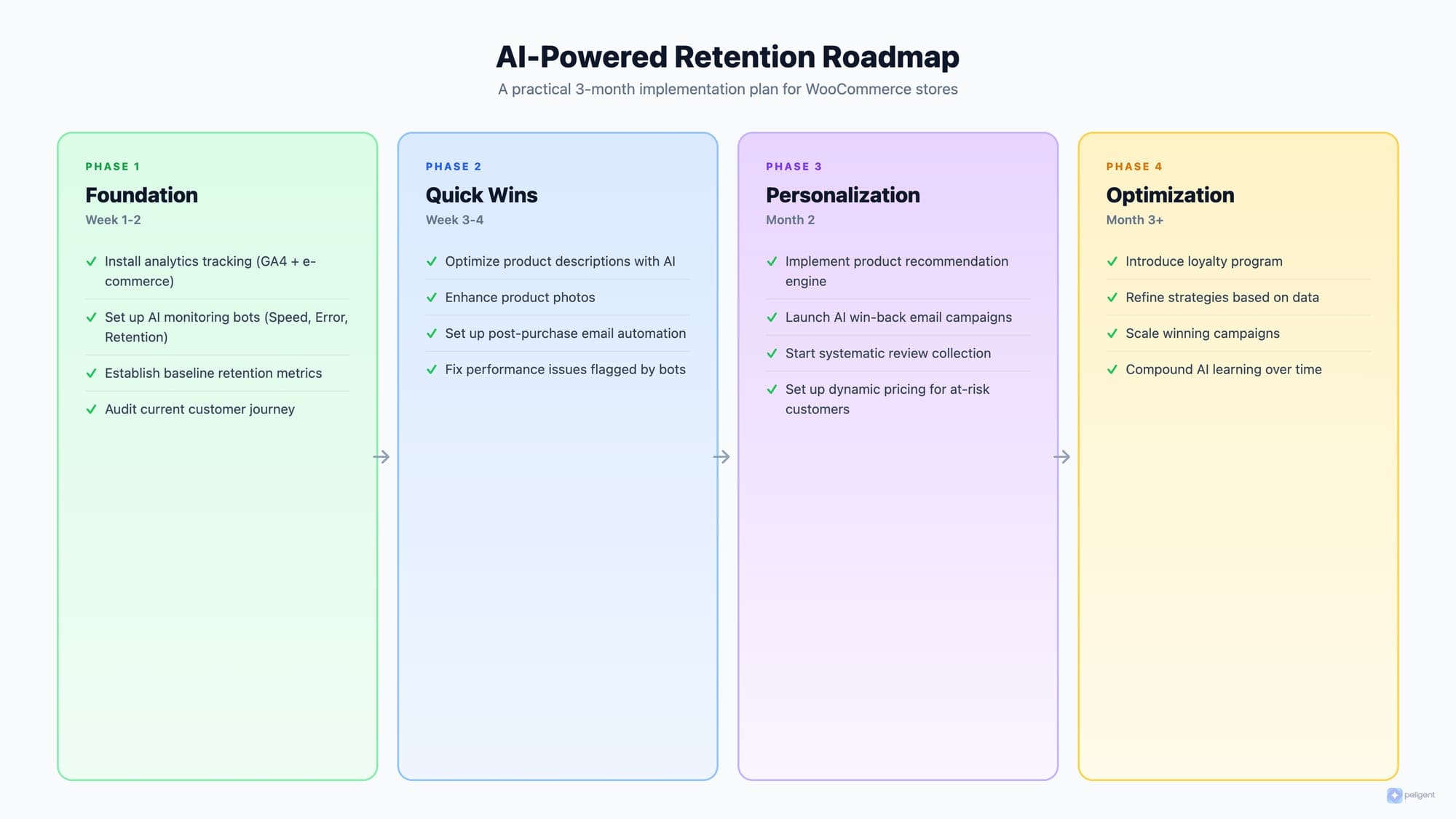
You do not need to implement all 10 strategies at once. Here is a practical roadmap for building your AI-powered retention stack:
Week 1-2: Foundation
- Install analytics tracking (Google Analytics 4 with e-commerce events)
- Set up Peligent for automated monitoring (Speed Bot, Error Log Bot, Retention Bot)
- Establish baseline retention metrics
Week 3-4: Quick Wins
- Optimize product descriptions with AI content generation
- Enhance product photos with AI photo tools
- Set up basic post-purchase email automation
Month 2: Personalization
- Implement product recommendation engine
- Launch AI-powered win-back email campaigns
- Start collecting and responding to reviews systematically
Month 3: Optimization
- Introduce a loyalty program
- Implement dynamic pricing for at-risk customers
- Refine all strategies based on data from the first two months
The beauty of AI-powered retention is that it compounds. Each strategy feeds data back into the system, making predictions more accurate and personalization more effective over time.
Frequently Asked Questions
What is a good customer retention rate for WooCommerce stores?
A good customer retention rate for e-commerce stores typically ranges from 20% to 40%. Top-performing WooCommerce stores achieve 40% or higher. However, this varies significantly by niche. Stores selling consumable products naturally have higher retention rates than those selling one-time purchases. The key is to measure your current rate and work on improving it consistently.
How does AI improve customer retention compared to manual methods?
AI improves retention in three key ways: speed, scale, and accuracy. AI can analyze thousands of customer data points simultaneously to predict churn before it happens. It can personalize communications for every individual customer, which is impossible to do manually at scale. And AI continuously learns from results, improving its predictions and recommendations over time.
Which AI tools work best with WooCommerce for customer retention?
Peligent is designed specifically for WordPress and WooCommerce, offering automated monitoring bots (including a dedicated Retention Bot), AI content generation, and performance tracking. For email automation, tools like Klaviyo and Mailchimp offer AI-powered features. For recommendations, plugins like Recommendation Engine for WooCommerce use machine learning. The best approach is combining a WooCommerce-native tool like Peligent with specialized tools for email and recommendations.
How long does it take to see results from AI-powered retention strategies?
Quick wins like product description optimization and performance monitoring can show results within days. Email-based strategies typically show measurable impact within 30 to 60 days. Loyalty programs and personalization strategies take 60 to 90 days to generate meaningful data. Full retention stack optimization usually takes 3 to 6 months to reach its potential, as AI models need time to learn from your specific customer data.
Can small WooCommerce stores benefit from AI retention tools?
Absolutely. AI retention tools are especially valuable for small stores because they automate work that would otherwise require dedicated staff. A small store owner cannot manually analyze every customer's purchase patterns, but AI can. Tools like Peligent start with a free tier (500,000 credits), making AI-powered retention accessible regardless of store size. Even basic strategies like automated churn alerts and AI-optimized product descriptions can significantly impact a small store's bottom line.
Written by
Wana DaliriAI content writer at Peligent. Covering WordPress, WooCommerce, and AI for e-commerce.
Enjoyed this article?
Subscribe to get more WooCommerce insights delivered to your inbox.
Related Articles
View all
WooCommerce Product Recommendations: How AI Personalizes Every Visit
Default related products only match tags. See how AI product recommendations use real shopper behavior to lift conversions, order value, and revenue.
WooCommerce AEO: How to Get Your Products Recommended by AI
Answer engine optimization for WooCommerce: how to get your products cited and recommended by ChatGPT, Perplexity, and Google AI Overviews in 2026.

WooCommerce CSV Import: How to Bulk Upload Products Without the Headaches
A practical 2026 guide to importing WooCommerce products from a CSV file, fixing the errors that break most imports, and cleaning up your catalog with AI.