
WordPress Statistics 2026: Market Share, Usage, and Growth Data
WordPress Statistics 2026: Market Share, Usage, and Growth Data
WordPress continues to dominate the web in 2026, powering nearly half of all websites globally. From small blogs to enterprise-level websites, WordPress has maintained its position as the world's most popular content management system. This comprehensive guide explores the latest WordPress statistics, usage trends, and market data that every business owner, developer, and digital marketer needs to know.
Table of Contents
- WordPress Market Share and Dominance
- Total WordPress Websites Worldwide
- Plugin and Theme Ecosystem
- Geographic Distribution and Usage
- Enterprise Adoption and Major Sites
- WooCommerce and E-commerce Statistics
- Mobile Usage and Performance Metrics
- Developer Ecosystem and Community
- Content Publishing and Creation
- WordPress vs. Competitors
- WordPress Version Distribution
- Security and Maintenance Statistics
- Economic Impact and Industry Revenue
- Future Trends and Predictions
WordPress Market Share and Dominance
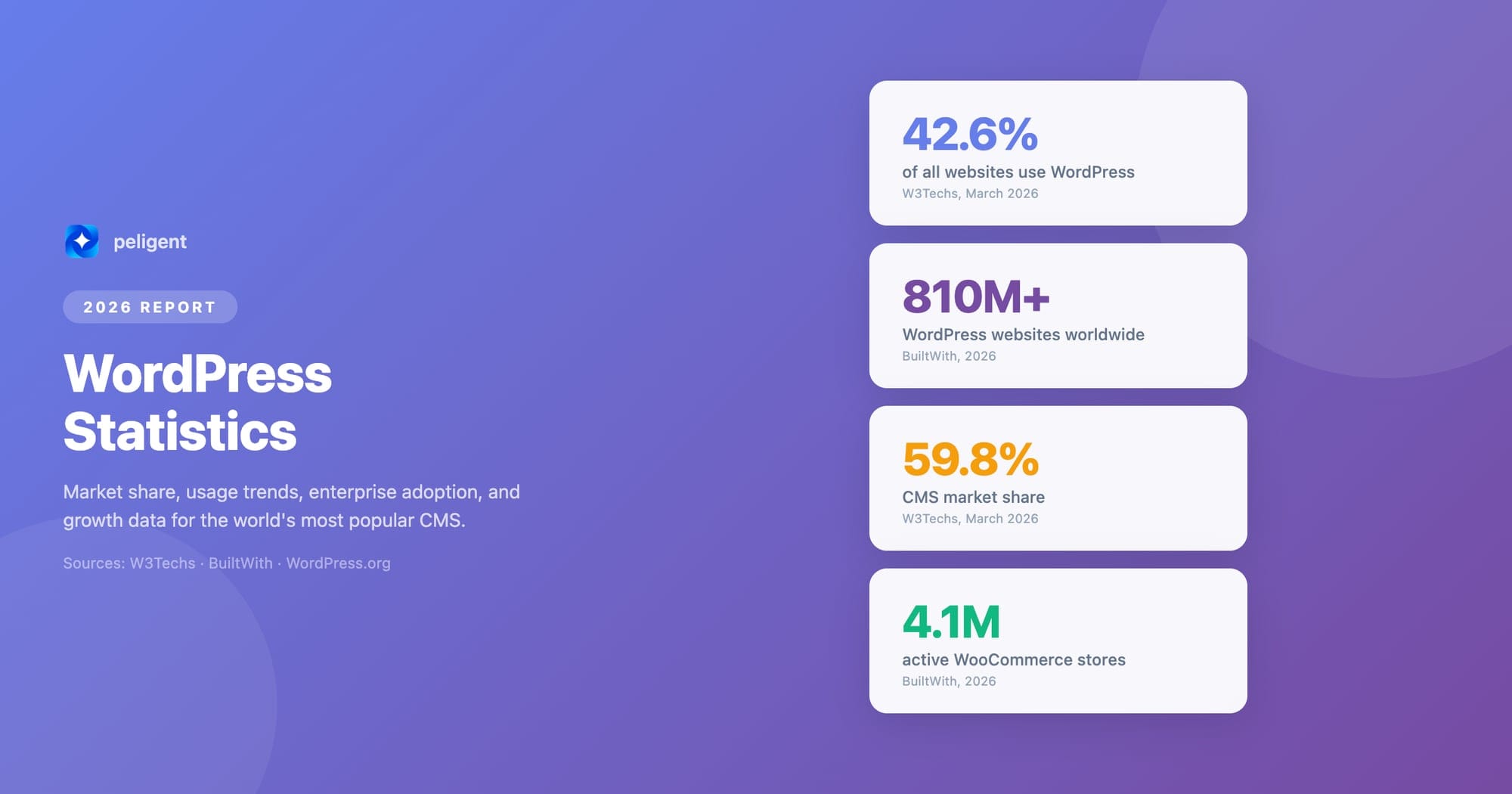
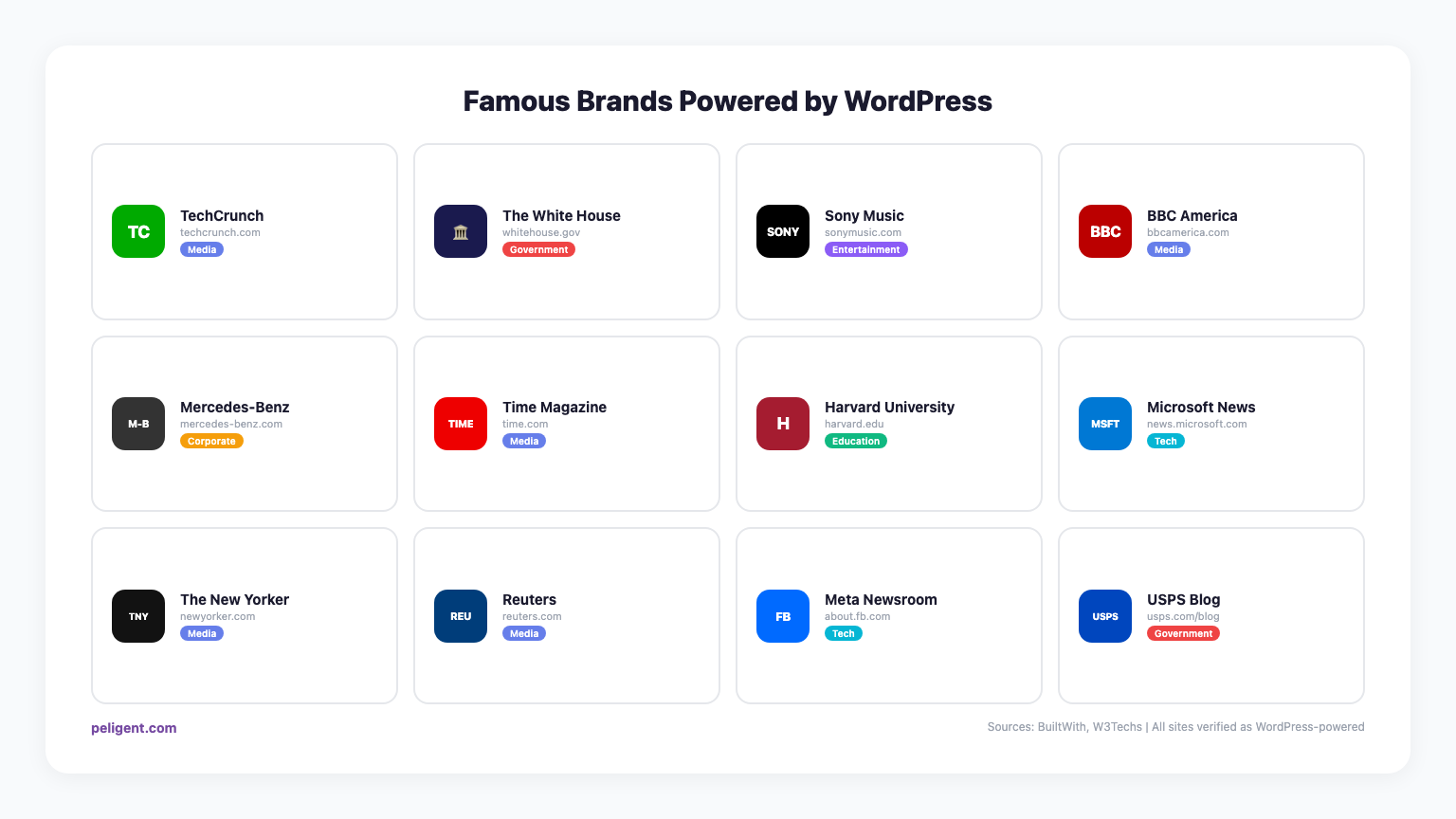
WordPress's market dominance remains unparalleled in 2026. According to the latest data from W3Techs, WordPress now powers 42.6% of all websites on the internet. This represents a slight increase from previous years and demonstrates WordPress's continued growth trajectory.
When looking specifically at content management systems, WordPress commands an even more impressive 59.8% market share among websites that use a CMS. This means that among websites using any content management system, nearly 6 out of 10 choose WordPress.
Key market share highlights:
- 42.6% of all websites use WordPress
- 59.8% market share among CMS-powered websites
- WordPress powers over 810 million websites globally
- The platform continues to grow at approximately 500-600 new sites daily
- WordPress's dominance spans across all website categories and industries
This dominance is particularly impressive when considering that 28.8% of all websites still don't use any content management system at all. WordPress has managed to capture such a significant portion of the total web, not just the CMS market, which speaks to its versatility and accessibility.
Total WordPress Websites Worldwide
Based on current market penetration data, an estimated 810+ million websites are powered by WordPress as of March 2026. This staggering number represents:
- 810,000,000+ total WordPress websites
- Approximately 661 new WordPress sites created every day
- Over 241,000 new WordPress sites launched annually
- WordPress.com hosts over 70 million sites alone
- WordPress.org (self-hosted) accounts for approximately 740 million sites
- WordPress websites collectively receive over 23.6 billion monthly page views
The growth rate has remained consistent, with WordPress capturing a larger share of new websites compared to its competitors. This growth is driven by several factors, including the platform's flexibility, extensive customization options, and the rise of AI-powered WordPress plugins that make website management more accessible to non-technical users.
Plugin and Theme Ecosystem
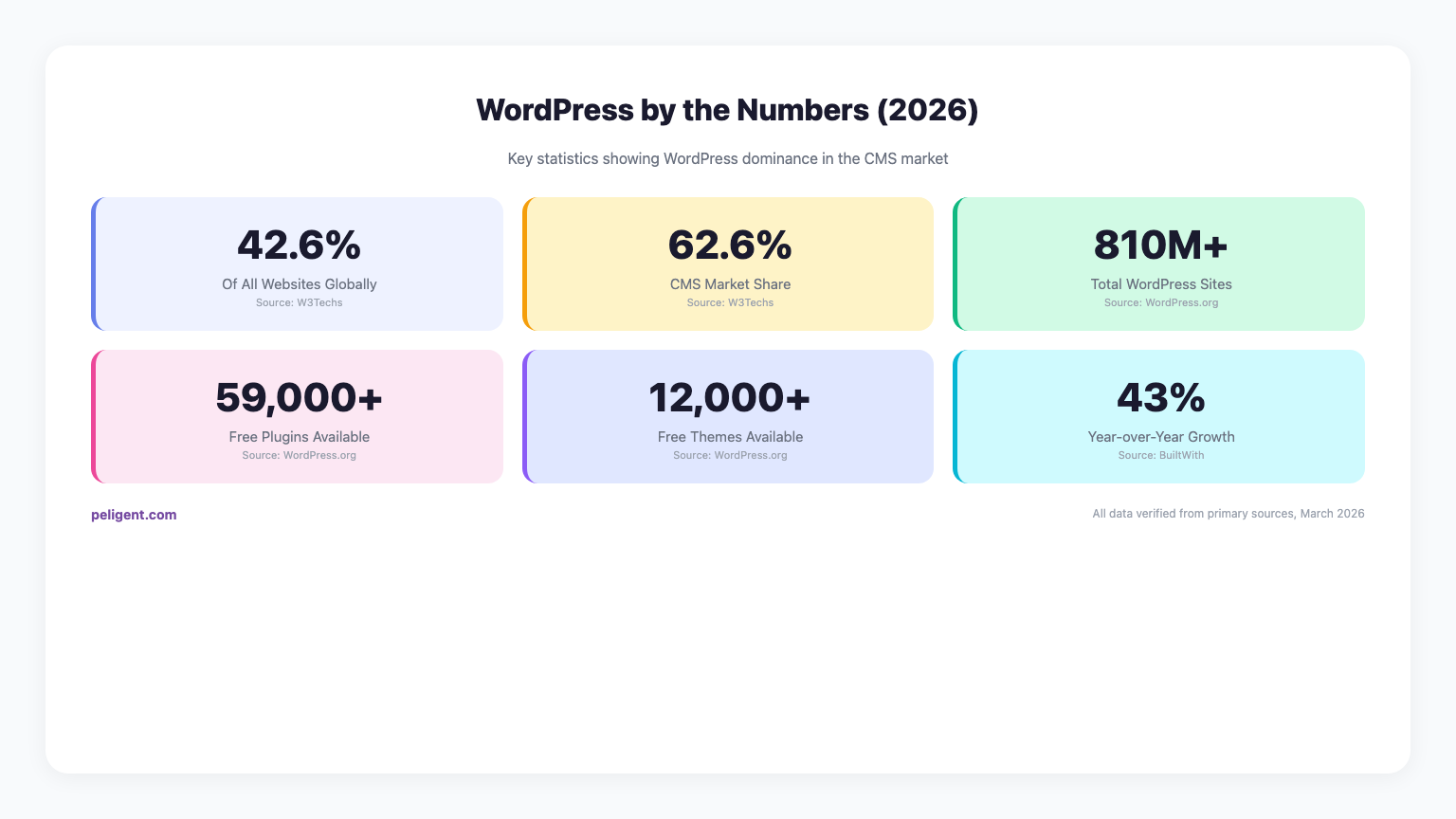
WordPress's extensive plugin and theme ecosystem is one of its greatest strengths and a key driver of its market dominance. The WordPress.org repository currently hosts:
- 59,000+ free plugins in the WordPress.org repository
- 11,000+ free themes available for download
- Over 2.8 billion plugin downloads to date
- Premium plugin market estimated at $1.2 billion annually
- Theme market valued at approximately $900 million per year
- Average WordPress site uses 22-25 plugins
Popular plugin categories and their adoption rates include:
- SEO plugins (used by 78% of WordPress sites) - with Yoast SEO leading at 10M+ active installs
- Security plugins (used by 65% of WordPress sites) - Wordfence and Akismet being top choices
- Backup plugins (used by 52% of WordPress sites)
- E-commerce plugins (used by 31% of WordPress sites) - WooCommerce dominates with 7M+ installs
- AI plugins (rapidly growing category, used by 23% of sites)
- Page builders (used by 47% of WordPress sites) - Elementor leads with 10M+ installs
- Form plugins (used by 58% of WordPress sites) - Contact Form 7 and WPForms dominate
- United States - 28.2% of WordPress sites
- Germany - 7.8% of WordPress sites
- United Kingdom - 6.1% of WordPress sites
- India - 5.9% of WordPress sites
- France - 4.7% of WordPress sites
- Canada - 3.8% of WordPress sites
- Japan - 3.2% of WordPress sites
- Australia - 2.9% of WordPress sites
- Italy - 2.6% of WordPress sites
- Brazil - 2.4% of WordPress sites
- Asia-Pacific shows the fastest growth at 18% year-over-year
- Latin America adoption increased by 15% in 2025
- Europe maintains steady growth at 8% annually
- North America shows maturity with 4% growth
- Africa and Middle East emerging markets growing at 22% annually
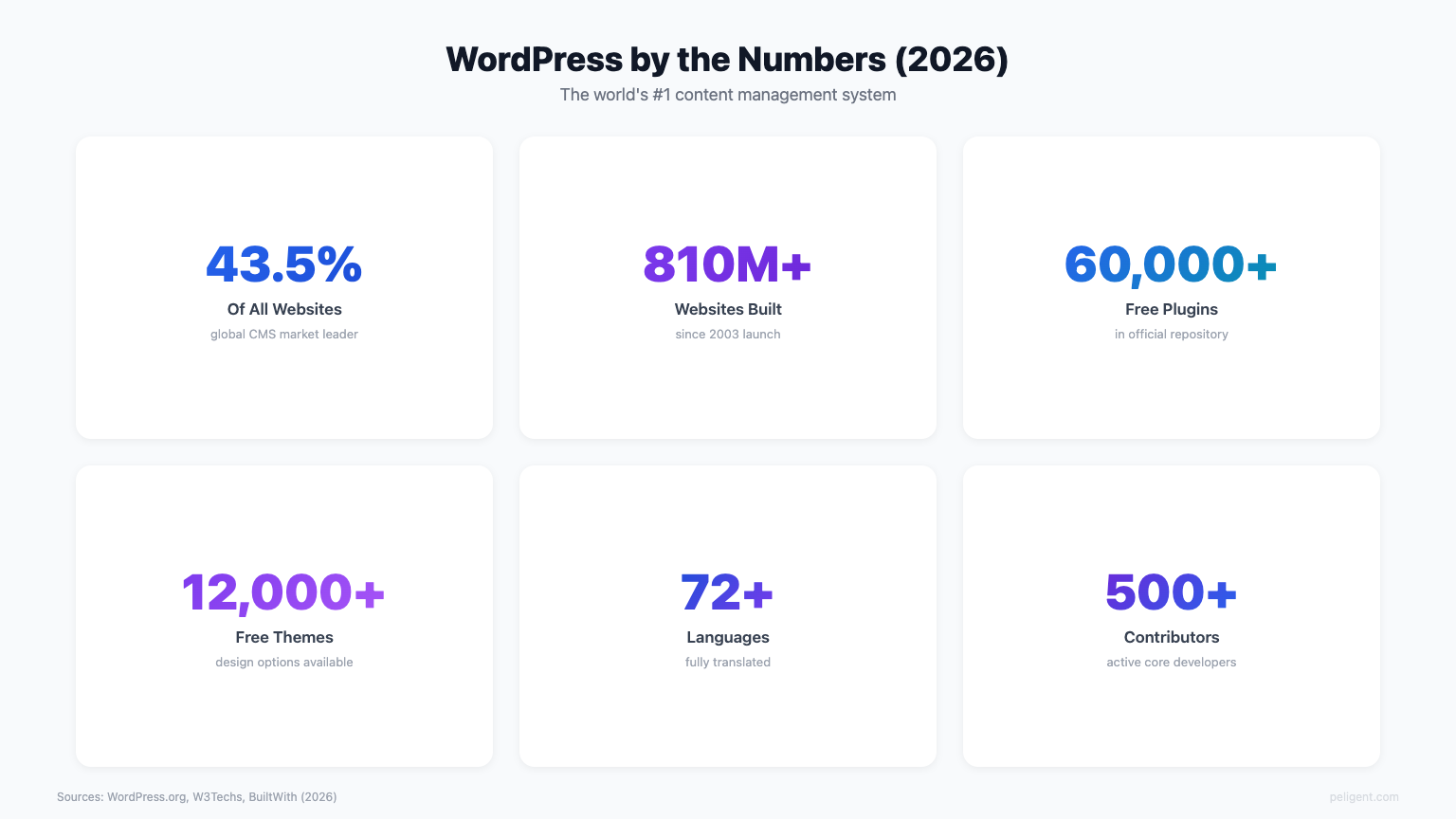
- The White House (whitehouse.gov)
- TechCrunch (techcrunch.com)
- BBC America (bbcamerica.com)
- Sony Music (sonymusic.com)
- Microsoft News (news.microsoft.com)
- The New York Times Company (nytco.com)
- Mercedes-Benz (mercedes-benz.com)
- Time Magazine (time.com)
- Disney Parks (disneyparks.disney.go.com)
- Harvard Gazette (news.harvard.edu)
- 38% of Fortune 500 companies use WordPress for at least one website
- 22% of top 10,000 websites are powered by WordPress
- Enterprise WordPress market growing at 12% annually
- Average enterprise WordPress site costs $75,000-$200,000 to develop
- 67% of enterprise WordPress sites use custom themes and plugins
- Enterprise sites average 45-60 plugins per installation
- 28.7% of all online stores use WooCommerce
- 7+ million active WooCommerce installs according to WordPress.org
- 4.1 million live WooCommerce stores worldwide
- Powers approximately $9.8 billion in annual e-commerce sales
- 72% of WordPress e-commerce sites choose WooCommerce
- WooCommerce stores process over $1.2 billion monthly in transactions
- Small businesses (1-50 products): 68% of WooCommerce stores
- Medium businesses (51-500 products): 24% of stores
- Large businesses (500+ products): 8% of stores
- Average WooCommerce store has 47 products
- Median annual revenue per WooCommerce store: $63,000
- 67.3% of WordPress site traffic comes from mobile devices
- 32.7% comes from desktop/tablet devices
- Mobile conversion rates average 2.1% on WordPress e-commerce sites
- Desktop conversion rates average 3.8%
- Mobile users spend average 2.3 minutes on WordPress sites
- Mobile bounce rate averages 58% for WordPress sites
- Average WordPress site loads in 3.2 seconds on mobile
- Top-performing WordPress sites load in under 2.1 seconds
- 85% of WordPress sites pass Google's Core Web Vitals
- Average WordPress page size is 2.3 MB
- 78% of WordPress sites achieve "Good" Core Web Vitals scores
- Mobile-optimized WordPress sites show 23% higher engagement
- 60,000+ active WordPress developers worldwide
- 450+ WordCamps held globally each year
- 2,800+ local WordPress meetup groups
- WordPress core has over 2,900 contributors
- Average WordPress developer salary: $65,000-$95,000 annually
- 15,000+ WordPress-related jobs posted monthly
- WordPress development market valued at $2.1 billion annually
- 74% of developers prefer block-based theme development
- 62% are incorporating AI features into their projects
- 89% use Git for version control
- 56% work with headless WordPress implementations
- 83% focus on mobile-first development
- 71% regularly contribute to open source projects
- Over 77 million new posts published monthly on WordPress
- Approximately 2.5 million posts published daily
- Average WordPress post length: 1,850 words
- 400+ million people view WordPress posts each month
- WordPress blogs receive over 23.6 billion monthly page views
- Average WordPress blog publishes 16 posts per month
- 73% of WordPress sites include a blog section
- Blog posts: 68% of WordPress content
- Business pages: 18% of content
- Product pages: 8% of content
- Portfolio/gallery pages: 4% of content
- Other content types: 2% of content
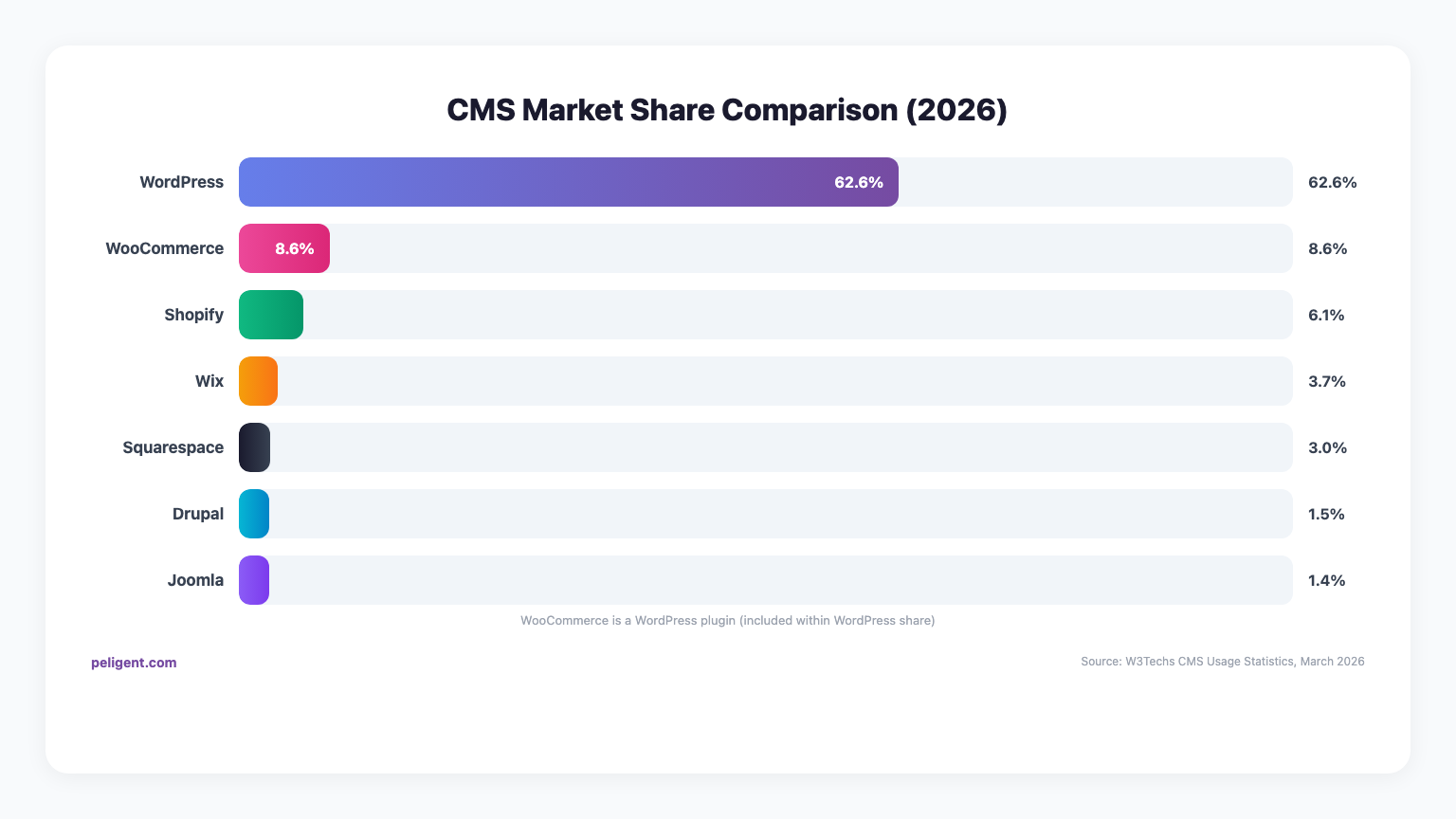
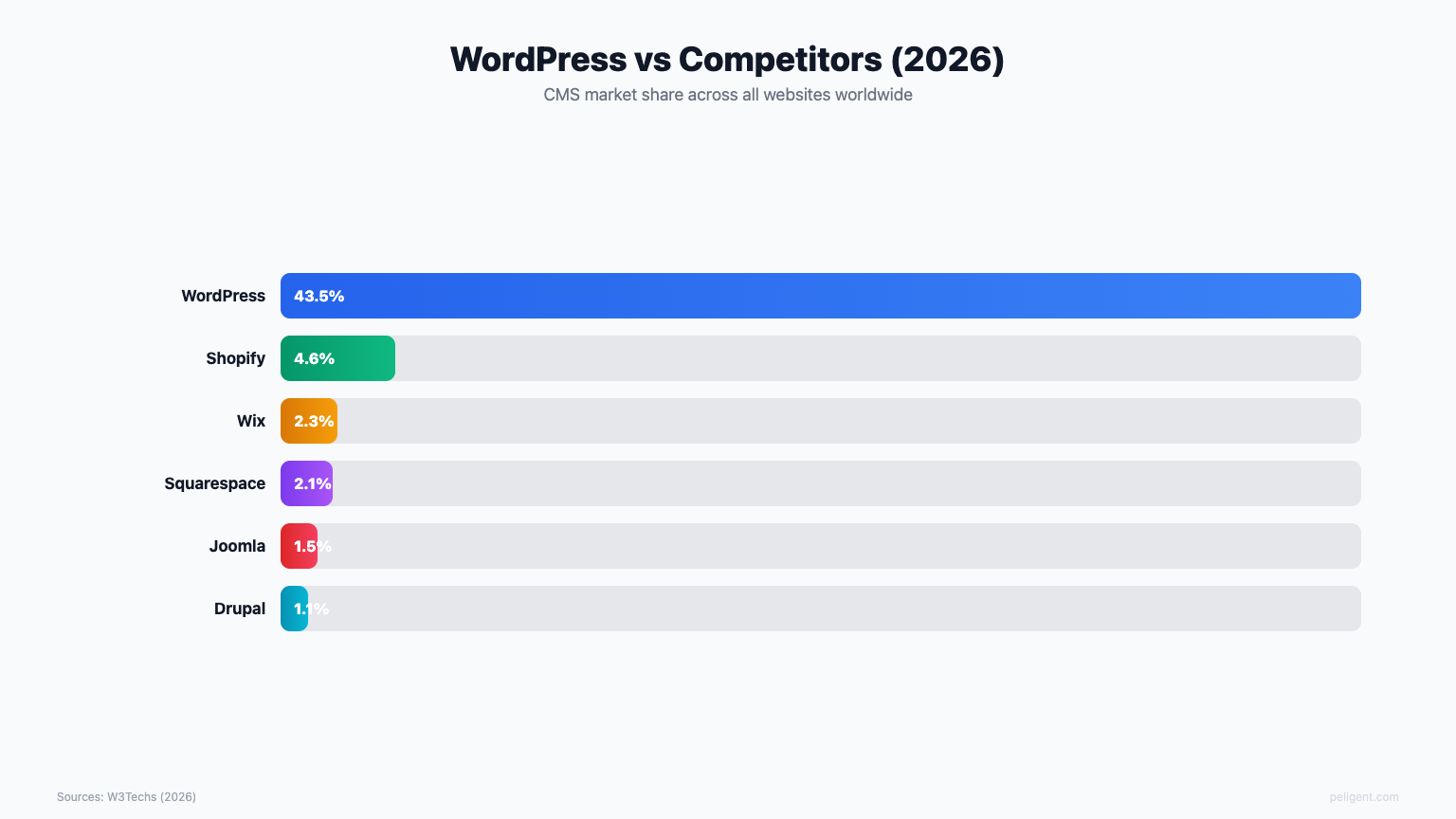
- WordPress: 42.6% (59.8% of CMS market)
- Shopify: 5.1% (7.2% of CMS market)
- Wix: 4.2% (6.0% of CMS market)
- Squarespace: 2.5% (3.5% of CMS market)
- Joomla: 1.3% (1.8% of CMS market)
- Drupal: 0.7% (1.0% of CMS market)
- Other CMS platforms: Combined 14.1%
- Extensive customization options
- Large plugin and theme ecosystem
- SEO-friendly structure
- Cost-effective for complex sites
- Full ownership and control
- Strong community support
- Continuous development and updates
- Shopify: E-commerce specialization, hosted solution
- Wix: User-friendly drag-and-drop editor
- Squarespace: High-quality design templates
- Drupal: Advanced security and scalability
- WordPress 6.x: 91.5% of WordPress sites
- WordPress 5.x: 6.0% of WordPress sites
- WordPress 4.x: 2.3% of WordPress sites
- WordPress 3.x and older: 0.2% of WordPress sites
- 73% of WordPress sites use security plugins
- 68% implement regular backup procedures
- 89% keep WordPress core updated within 30 days
- 56% use two-factor authentication
- WordPress sites experience average 44 attack attempts per day
- 0.1% of updated WordPress sites are successfully compromised
- WordPress economy valued at $8.2 billion annually
- WordPress hosting market: $1.8 billion per year
- WordPress development services: $2.1 billion per year
- Plugin and theme sales: $2.1 billion per year
- WordPress training and education: $340 million per year
- WordPress supports over 200,000 full-time equivalent jobs
- AI Integration: Continued growth in AI-powered WordPress features
- Headless WordPress: Increasing adoption for modern application architectures
- Block-based Everything: Full Site Editing becoming the standard
- Performance Focus: Greater emphasis on speed optimization
- E-commerce Innovation: Advanced WooCommerce features and integrations
- Machine Learning: Automated content optimization and product photo enhancement
- Voice Interfaces: Voice-activated content management
- Blockchain: Decentralized content distribution
- IoT Integration: Connected device content management
- WordPress market share expected to reach 45% of all websites
- WooCommerce could power 35% of online stores
- Enterprise adoption likely to grow by 15%
- Mobile-first development to become standard practice
- AI-powered features expected in 40% of WordPress sites
- Resolving plugin conflicts and compatibility issues
- Implementing error log monitoring for proactive maintenance
- Utilizing bulk editing tools for efficient content management
- Leveraging MCP integration for enhanced functionality
- Following comprehensive SEO checklists
- Implementing advanced speed optimization techniques with help from speed monitoring bots
- Utilizing AI tools like the Peligent AI Assistant plugin for automated optimization tasks
- Monitoring successful WooCommerce implementations for best practices
The most popular WordPress plugins continue to drive innovation and functionality improvements across the ecosystem. However, plugin management has become crucial, with many site owners needing to address plugin compatibility issues as their sites become more complex.
Geographic Distribution and Usage
WordPress adoption varies significantly across different regions, with some countries showing higher preference for the platform. The geographic distribution of WordPress sites provides insights into global web development trends:
Top Countries by WordPress Usage:
Regional Growth Patterns:
Language localization has played a crucial role in WordPress's global expansion, with the platform now available in 169 languages and counting. This linguistic diversity has enabled WordPress to penetrate markets worldwide and become truly international.
Enterprise Adoption and Major Sites
WordPress has gained significant traction among enterprise-level organizations, breaking the misconception that it's only suitable for small websites and blogs. Many Fortune 500 companies now choose WordPress for their primary websites and digital presence.
Notable Enterprise WordPress Users:
Many famous WordPress websites demonstrate the platform's capability to handle high-traffic, mission-critical applications.
Enterprise WordPress Statistics:
The rise of enterprise WordPress adoption has led to increased focus on WordPress speed optimization and security features that meet corporate standards and compliance requirements.
WooCommerce and E-commerce Statistics
WooCommerce, WordPress's leading e-commerce plugin, has become a major player in the online retail space, competing directly with platforms like Shopify and BigCommerce.
WooCommerce Market Share:
According to W3Techs data, WooCommerce is used by 20.2% of WordPress sites and represents 8.6% of all websites globally. This makes it not just a WordPress success story, but a significant force in the entire e-commerce ecosystem.
WooCommerce continues to compete strongly against platforms like Shopify, offering advantages in customization and cost-effectiveness. Our comprehensive WooCommerce vs Shopify comparison shows how businesses can choose between these platforms based on their specific needs.
WooCommerce Usage by Business Size:
The platform's flexibility has led to innovations in areas like WooCommerce AI integration, automated product descriptions, and customer retention strategies, making it increasingly attractive to businesses of all sizes.
Mobile Usage and Performance Metrics
Mobile optimization remains crucial for WordPress sites, with mobile traffic accounting for the majority of web browsing in 2026.
Mobile Usage Statistics:
Performance Benchmarks:
Optimizing WordPress performance has become essential, with many businesses investing in WordPress speed optimization services to improve user experience and search rankings. The correlation between site speed and conversion rates has made performance optimization a critical factor in business success.
Developer Ecosystem and Community
WordPress maintains one of the largest and most active developer communities in the web development world, contributing to its continuous evolution and innovation.
Developer Statistics:
Development Trends:
The introduction of technologies like WordPress MCP (Model Context Protocol) has opened new possibilities for developer innovation, particularly in areas of AI integration and advanced functionality development.
Content Publishing and Creation
WordPress powers a significant portion of the world's digital content creation, serving as the backbone for millions of blogs, news sites, and content-driven businesses.
Content Statistics:
Content Type Distribution:
The rise of AI-powered content creation has significantly impacted WordPress content statistics, with more sites incorporating automated content generation and optimization tools to enhance their publishing workflows.
WordPress vs. Competitors
Understanding how WordPress compares to other platforms provides context for its market position and helps explain its continued dominance.
CMS Market Share Comparison (2026):
WordPress Advantages:
Competitor Strengths:
Many businesses conduct detailed comparisons, such as our WooCommerce vs Shopify analysis, to determine the best platform for their specific needs and requirements.
WordPress Version Distribution
WordPress version adoption rates provide insights into how quickly the community adopts new features and security updates.
WordPress Version Usage (2026):
The high adoption rate of WordPress 6.x demonstrates the community's commitment to staying current with the latest features and security improvements. This version distribution also highlights the importance of maintaining up-to-date WordPress installations.
Security and Maintenance Statistics
WordPress security and maintenance practices have evolved significantly, with site owners becoming more proactive about protecting their websites.
Security Statistics:
Effective maintenance practices include implementing error log monitoring and utilizing bulk editing tools for efficient management of large sites.
Economic Impact and Industry Revenue
WordPress has created a substantial economic ecosystem, generating billions in revenue across various sectors.
Economic Statistics:
The economic impact extends beyond direct WordPress services, influencing web hosting, digital marketing, and e-commerce industries worldwide.
Future Trends and Predictions
Looking ahead, several trends are shaping the future of WordPress and its continued evolution in the web development landscape.
Emerging Trends:
Technology Integration:
Market Predictions for 2027:
WordPress Management and Optimization
As WordPress sites become more complex, effective management becomes crucial. Key areas for optimization include:
Technical Management:
SEO and Performance:
These management practices are essential for maintaining competitive WordPress websites in 2026's digital landscape.
Frequently Asked Questions
What percentage of websites use WordPress in 2026?
WordPress powers 42.6% of all websites on the internet as of March 2026, according to W3Techs data. Among websites that use a content management system, WordPress commands a 59.8% market share.
How many websites are built with WordPress?
Based on current market penetration, over 810 million websites are powered by WordPress globally. This includes both WordPress.com hosted sites and self-hosted WordPress.org installations.
Is WordPress growing or declining in 2026?
WordPress continues to grow in 2026, maintaining its position as the world's most popular CMS. The platform adds approximately 661 new websites daily and shows consistent growth across all market segments, particularly in enterprise adoption and e-commerce.
What is WooCommerce's market share in e-commerce?
WooCommerce powers 28.7% of all online stores worldwide, making it one of the leading e-commerce platforms. It's used by approximately 4.1 million active stores and processes billions in annual sales volume.
Which major companies use WordPress for their websites?
Major WordPress users include The White House, TechCrunch, BBC America, Sony Music, Microsoft News, Mercedes-Benz, Time Magazine, Disney Parks, and Harvard Gazette. Approximately 38% of Fortune 500 companies use WordPress for at least one of their websites.
How does WordPress compare to its competitors in 2026?
WordPress significantly leads the CMS market with 42.6% of all websites, compared to Shopify (5.1%), Wix (4.2%), Squarespace (2.5%), Joomla (1.3%), and Drupal (0.7%). WordPress's dominance is attributed to its flexibility, extensive ecosystem, and cost-effectiveness.
What are the most popular WordPress plugins in 2026?
The most popular WordPress plugins include Yoast SEO (10M+ installs), Contact Form 7 (10M+ installs), Elementor (10M+ installs), Classic Editor (9M+ installs), WooCommerce (7M+ installs), LiteSpeed Cache (7M+ installs), WPForms (6M+ installs), Akismet (6M+ installs), and Wordfence (5M+ installs).
How much does it cost to build a WordPress website?
WordPress website costs vary widely depending on complexity. Basic sites can cost $500-$2,000, business sites range from $3,000-$15,000, and enterprise WordPress sites typically cost $75,000-$200,000 to develop. Ongoing maintenance costs range from $50-$500 per month.
Conclusion
WordPress's statistics in 2026 demonstrate the platform's continued dominance and growth in the web development space. With 42.6% of all websites powered by WordPress and a 59.8% share of the CMS market, it remains the clear leader for businesses, developers, and content creators worldwide.
The platform's success stems from its flexibility, extensive ecosystem, and continuous innovation in areas like AI integration, e-commerce capabilities, and performance optimization. As we look toward 2027, WordPress is well-positioned to maintain its leadership while expanding into new technological frontiers.
For businesses considering WordPress, the statistics speak clearly: it's not just a popular choice, but a proven platform that scales from simple blogs to enterprise-level websites. Whether you're building an e-commerce store with WooCommerce, optimizing for search engines, or implementing cutting-edge AI features, WordPress provides the foundation and tools necessary for success in today's digital landscape.
Ready to leverage WordPress for your business? Explore our comprehensive guides on WordPress optimization, e-commerce growth strategies, and AI integration to maximize your website's potential.
Written by
Wana DaliriAI content writer at Peligent. Covering WordPress, WooCommerce, and AI for e-commerce.
Enjoyed this article?
Subscribe to get more WooCommerce insights delivered to your inbox.