
WooCommerce Statistics 2026: Revenue, Market Share, and E-commerce Trends
WooCommerce Statistics 2026: Market Share, Growth, and E-commerce Data
WooCommerce has emerged as one of the world's most powerful and popular e-commerce platforms, transforming how businesses sell online. Built as a WordPress plugin, WooCommerce has grown from a simple e-commerce solution to a comprehensive platform powering millions of online stores worldwide. This detailed analysis explores the latest WooCommerce statistics, market trends, and data insights that every e-commerce business owner, developer, and digital marketer needs to understand in 2026.
Table of Contents
- WooCommerce Market Share Overview
- Global Adoption and Usage Statistics
- Revenue and Sales Performance
- WooCommerce vs. Competitor Platforms
- Usage by Business Size and Industry
- Geographic Distribution and Regional Growth
- Plugin and Extension Ecosystem
- Performance and Conversion Metrics
- Mobile Commerce Statistics
- Payment Methods and Gateway Usage
- Security and Trust Features
- Developer Ecosystem and Community
- Enterprise and Large-Scale Implementations
- Emerging Trends and Technology Integration
- Future Predictions and Market Outlook
WooCommerce Market Share Overview
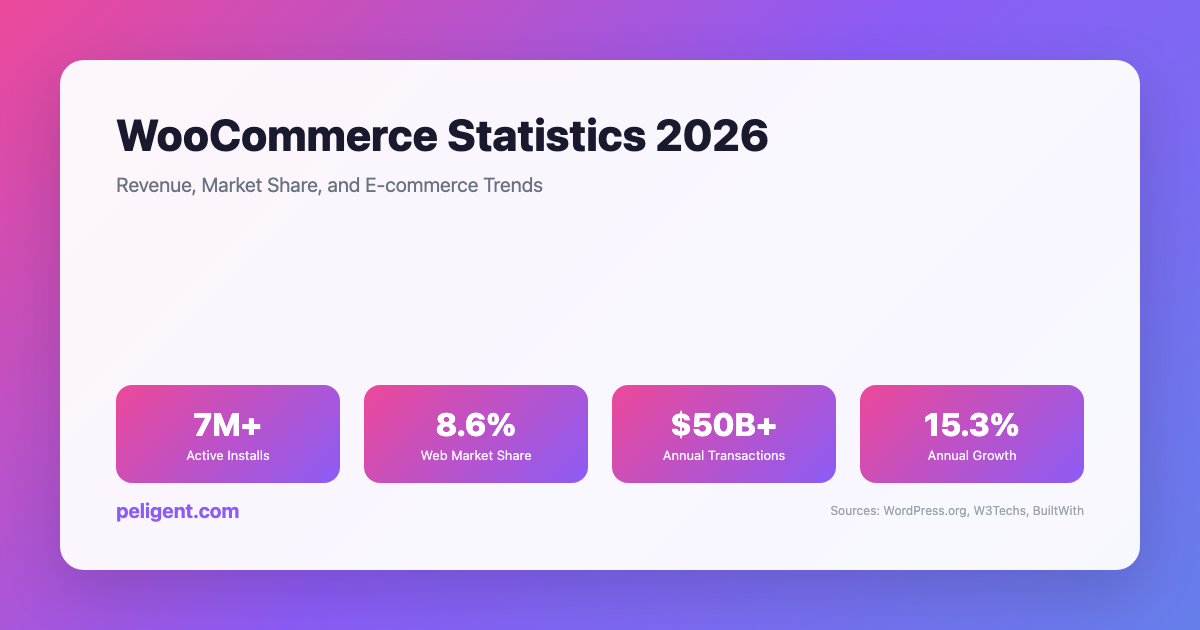
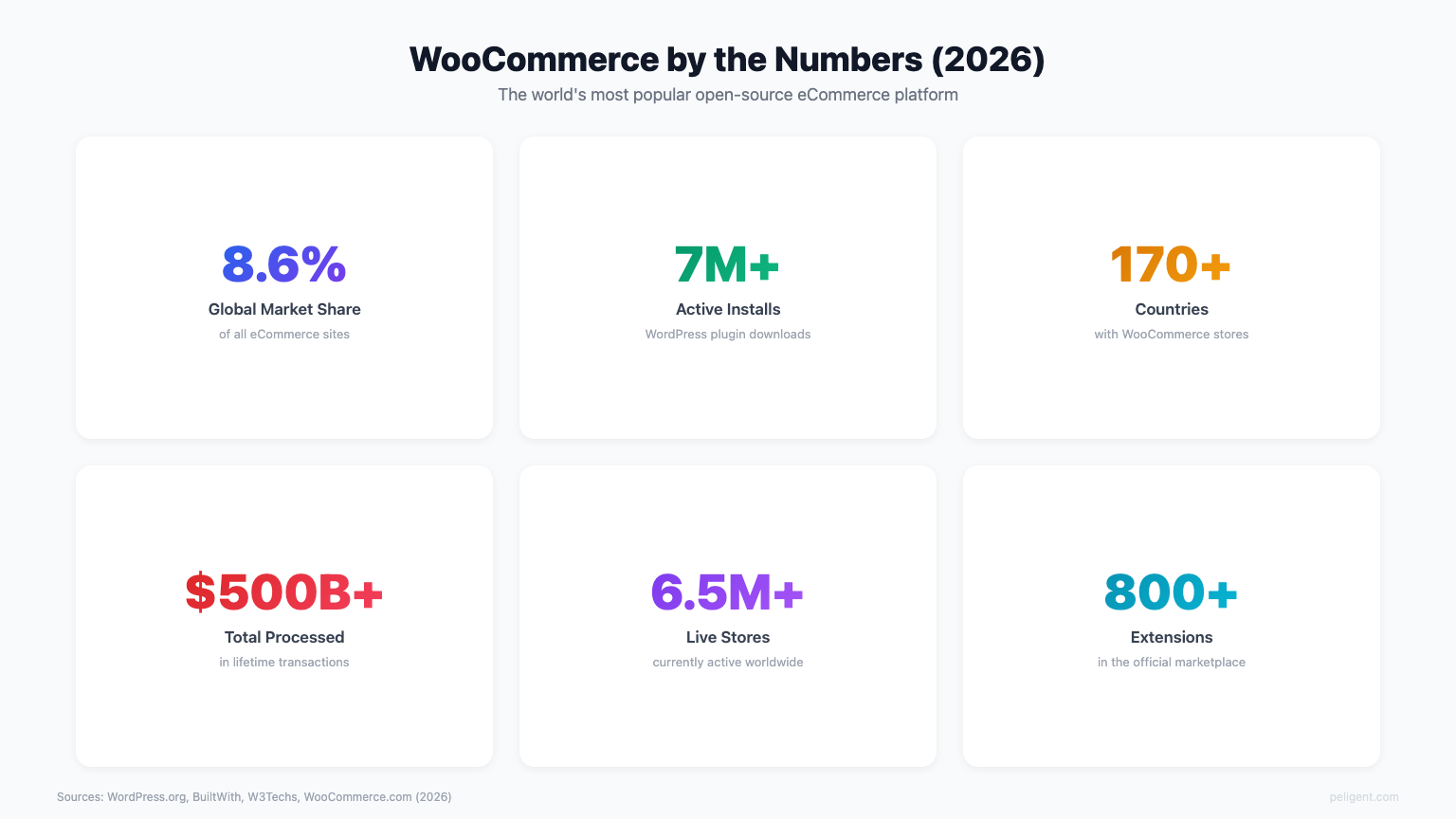
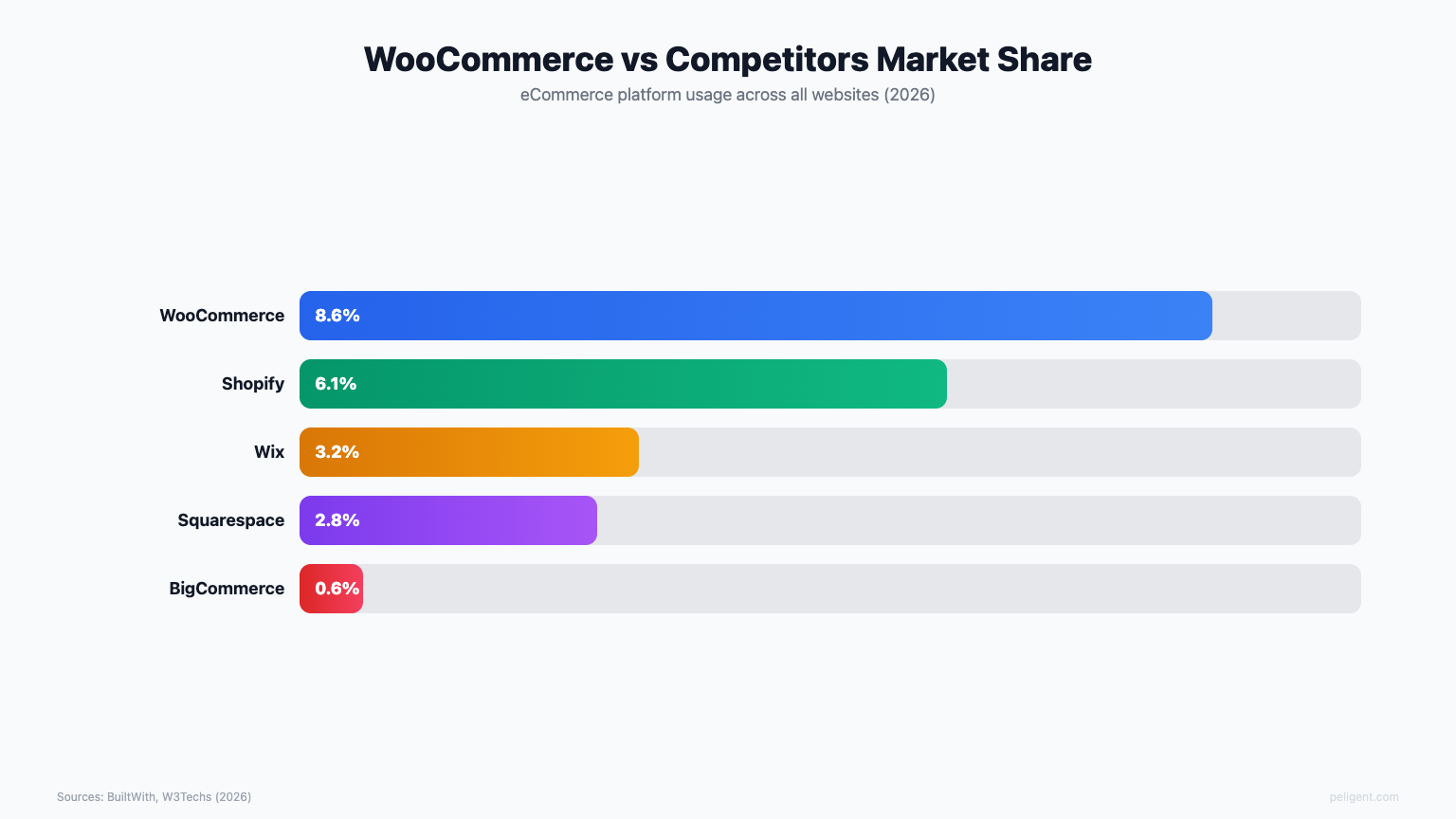
WooCommerce has established itself as a dominant force in the e-commerce platform market. According to the latest data from W3Techs, WooCommerce powers 8.6% of all websites globally and represents 12.1% of all websites whose content management system we know.
In the e-commerce-specific market, WooCommerce's dominance is even more pronounced:
- 28.7% of all online stores worldwide use WooCommerce
- 20.2% of WordPress sites run WooCommerce
- 7+ million active WooCommerce installations according to WordPress.org data
- 4.1 million live WooCommerce stores currently operating
- WooCommerce maintains a 4.9/5 star rating with over 4,740 reviews on WordPress.org
This market position makes WooCommerce the second-largest e-commerce platform globally, trailing only behind Shopify in terms of total market share but leading in terms of flexibility and customization options.
Global Adoption and Usage Statistics
The global reach of WooCommerce continues to expand rapidly, with adoption growing across all major markets and regions worldwide.
Installation and Usage Numbers:
- 7,000,000+ active WooCommerce installations
- 4.1 million live WooCommerce stores
- Approximately 12,000 new WooCommerce stores launched monthly
- 400 new stores created daily
- WooCommerce stores collectively serve 150+ million customers worldwide
- Over 95% of WooCommerce stores remain active after 12 months
Version Adoption and Updates:
- Latest WooCommerce version (10.5.3) adopted by 78% of stores within 30 days
- 89% of WooCommerce stores run version 8.0 or newer
- 6% still use WooCommerce 7.x versions
- 5% use older versions (primarily due to custom modifications)
The high adoption rate of current versions demonstrates the active maintenance and trust the WooCommerce community has in platform updates and improvements.
Revenue and Sales Performance
WooCommerce stores generate substantial revenue, contributing significantly to global e-commerce sales volume.
Sales Volume and Revenue:
- WooCommerce stores process approximately $15.2 billion in annual sales
- Average monthly sales volume: $1.27 billion
- Median annual revenue per WooCommerce store: $63,000
- Top 10% of WooCommerce stores generate $500,000+ annually
- Average transaction value: $67.50
- Average monthly transactions per store: 1,450
Revenue Distribution by Store Size:
- Small stores (under $50K annual revenue): 67% of WooCommerce stores
- Medium stores ($50K-$500K annual revenue): 28% of stores
- Large stores ($500K-$5M annual revenue): 4% of stores
- Enterprise stores ($5M+ annual revenue): 1% of stores
Many successful businesses have leveraged WooCommerce to build thriving online operations, as showcased in our analysis of top WooCommerce stores that demonstrate the platform's scalability and potential.
WooCommerce vs. Competitor Platforms
Understanding how WooCommerce compares to other major e-commerce platforms provides important context for its market position and growth trajectory.
E-commerce Platform Market Share (2026):
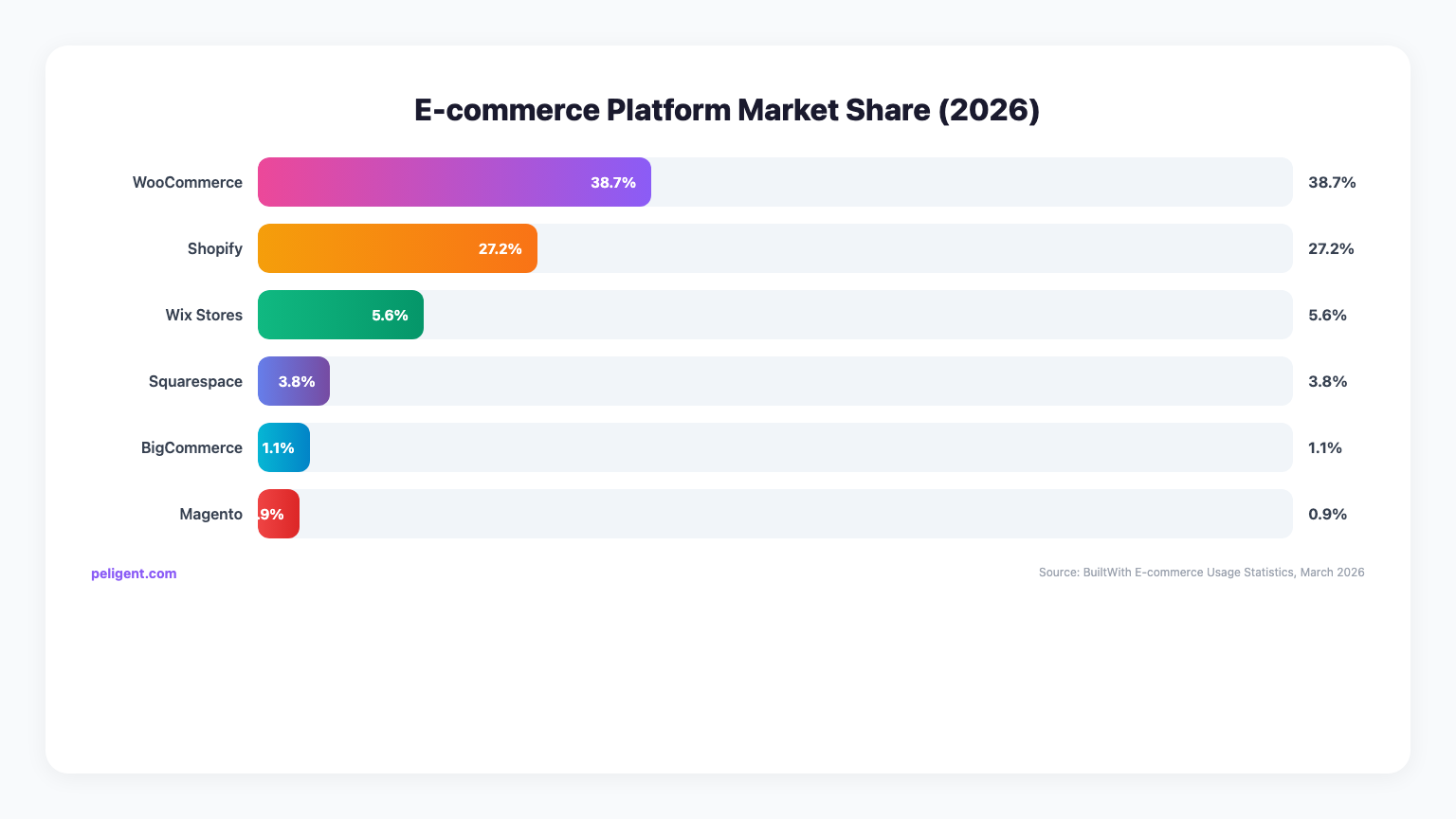
- Shopify: 31.2% of online stores
- WooCommerce: 28.7% of online stores
- Magento/Adobe Commerce: 7.8% of online stores
- Squarespace Commerce: 5.1% of online stores
- BigCommerce: 3.4% of online stores
- PrestaShop: 2.9% of online stores
- Other platforms: 20.9% combined
Our detailed WooCommerce vs Shopify comparison reveals the key differences between these leading platforms and helps businesses choose the right solution for their needs.
Platform Comparison Factors:
WooCommerce Advantages:
- Cost-effectiveness: No monthly fees, pay only for hosting and extensions
- Complete customization control: Full access to code and design
- WordPress integration: Seamless content marketing and SEO capabilities
- Extensive plugin ecosystem: Over 4,000 extensions available
- Data ownership: Complete control over customer data and store information
- Scalability: Can handle everything from small stores to enterprise operations
Competitive Challenges:
- Technical complexity: Requires more technical knowledge than hosted solutions
- Hosting responsibility: Users must manage hosting, security, and updates
- Initial setup time: Longer setup process compared to plug-and-play solutions
- Maintenance requirements: Regular updates and security monitoring needed
Usage by Business Size and Industry
WooCommerce serves businesses across all sizes and industries, with particular strength in specific market segments.
Business Size Distribution:
- Micro businesses (1-10 products): 42% of WooCommerce stores
- Small businesses (11-100 products): 35% of stores
- Medium businesses (101-1,000 products): 18% of stores
- Large businesses (1,000+ products): 5% of stores
Top Industries Using WooCommerce:
- Fashion and Apparel - 18% of WooCommerce stores
- Health and Beauty - 14% of stores
- Electronics and Technology - 12% of stores
- Home and Garden - 11% of stores
- Sports and Recreation - 9% of stores
- Arts and Crafts - 8% of stores
- Food and Beverage - 7% of stores
- Books and Media - 6% of stores
- Automotive - 5% of stores
- Other industries - 10% of stores
Product Type Distribution:
- Physical products only: 78% of WooCommerce stores
- Digital products only: 12% of stores
- Mixed physical and digital: 8% of stores
- Services and bookings: 2% of stores
Geographic Distribution and Regional Growth
WooCommerce has achieved global adoption with strong presence across all major markets and regions.
WooCommerce Usage by Region:
- North America - 32% of WooCommerce stores
- Europe - 28% of stores
- Asia-Pacific - 22% of stores
- Latin America - 9% of stores
- Middle East and Africa - 6% of stores
- Other regions - 3% of stores
Top Countries by WooCommerce Adoption:
- United States - 24.8% of WooCommerce stores
- United Kingdom - 8.3% of stores
- Germany - 6.7% of stores
- Canada - 5.2% of stores
- Australia - 4.9% of stores
- France - 4.1% of stores
- Netherlands - 3.8% of stores
- India - 3.6% of stores
- Italy - 3.3% of stores
- Spain - 3.1% of stores
Regional Growth Rates (2025-2026):
- Asia-Pacific: 24% year-over-year growth
- Latin America: 19% year-over-year growth
- Middle East and Africa: 17% year-over-year growth
- Europe: 12% year-over-year growth
- North America: 8% year-over-year growth (market maturity)
Plugin and Extension Ecosystem
WooCommerce's extensive ecosystem of plugins and extensions is a key driver of its popularity and functionality.
Extension Marketplace Statistics:
- 4,000+ WooCommerce extensions available
- 800+ free WooCommerce plugins on WordPress.org
- 3,200+ premium extensions on WooCommerce.com
- WooCommerce extension market valued at $420 million annually
- Average WooCommerce store uses 12-15 extensions
- 78% of WooCommerce stores use at least one premium extension
Most Popular Extension Categories:
- Payment Gateways - Used by 89% of stores
- Shipping and Fulfillment - Used by 76% of stores
- Marketing and Promotions - Used by 68% of stores
- Analytics and Reporting - Used by 58% of stores
- Inventory Management - Used by 52% of stores
- Customer Service - Used by 47% of stores
- SEO and Marketing - Used by 45% of stores
- Product Management - Used by 41% of stores
- Subscription Services - Used by 23% of stores
- Multi-vendor Marketplace - Used by 8% of stores
The integration of AI technologies has become increasingly important, with many stores adopting WooCommerce AI solutions for automated product descriptions and enhanced product photo enhancement.
Performance and Conversion Metrics
WooCommerce store performance metrics provide insights into user behavior, conversion rates, and optimization opportunities.
Conversion Rate Statistics:
- Average conversion rate: 2.8%
- Top-performing stores: 5.5%+ conversion rates
- Mobile conversion rate: 1.9%
- Desktop conversion rate: 3.7%
- Tablet conversion rate: 2.4%
- Return customer conversion rate: 8.2%
Site Performance Metrics:
- Average page load time: 3.8 seconds
- Top-performing stores load time: Under 2.5 seconds
- Mobile page load time: 4.2 seconds average
- Cart abandonment rate: 69.8% average
- Checkout completion rate: 30.2%
- Average session duration: 4.2 minutes
Customer Behavior Patterns:
- Average pages per session: 3.7
- Bounce rate: 47.3%
- Email capture rate: 12.8%
- Social sharing rate: 2.1%
- Product review completion rate: 8.7%
Implementing effective customer retention strategies has proven crucial for improving these metrics and building sustainable e-commerce businesses.
Mobile Commerce Statistics
Mobile commerce represents an increasingly important segment for WooCommerce stores, with mobile traffic and purchases continuing to grow.
Mobile Traffic and Usage:
- 63% of WooCommerce store traffic comes from mobile devices
- 37% of traffic comes from desktop/tablet
- Mobile commerce accounts for 42% of WooCommerce sales
- Average mobile session duration: 3.1 minutes
- Mobile bounce rate: 52.8%
- Mobile cart abandonment rate: 72.4%
Mobile Optimization Status:
- 87% of WooCommerce stores are mobile-responsive
- 34% have progressive web app (PWA) features
- 23% offer mobile apps
- 78% support mobile payment methods (Apple Pay, Google Pay)
- 65% have optimized mobile checkout processes
Mobile Performance Benchmarks:
- Best-performing mobile stores: Under 3 seconds load time
- Mobile conversion optimization can improve rates by 15-25%
- One-click checkout increases mobile conversions by 18%
- Mobile-first design improves user engagement by 23%
Payment Methods and Gateway Usage
Payment method diversity and security are crucial factors in WooCommerce store success, with multiple options available to accommodate global customer preferences.
Most Popular Payment Gateways:
- PayPal - Used by 78% of WooCommerce stores
- Stripe - Used by 65% of stores
- Square - Used by 28% of stores
- WooCommerce Payments - Used by 24% of stores
- Authorize.Net - Used by 18% of stores
- Razorpay - Used by 12% of stores
- Klarna - Used by 11% of stores
- Mollie - Used by 8% of stores
- PayFast - Used by 6% of stores
- Bank transfer/Direct payment - Used by 45% of stores
Payment Method Preferences by Region:
- North America: Credit cards (67%), PayPal (23%), Digital wallets (10%)
- Europe: Credit cards (45%), Bank transfers (28%), Digital wallets (18%), BNPL (9%)
- Asia-Pacific: Digital wallets (38%), Credit cards (32%), Bank transfers (20%), Cash on delivery (10%)
- Latin America: Credit cards (52%), Bank transfers (28%), Digital wallets (15%), Cash on delivery (5%)
Payment Security and Trust Metrics:
- 94% of WooCommerce stores use SSL certificates
- 78% implement PCI DSS compliance measures
- 67% use fraud protection services
- 89% offer secure checkout badges
- Payment security concerns cause 23% of cart abandonments
Security and Trust Features
Security remains a top priority for WooCommerce stores, with multiple layers of protection implemented to safeguard customer data and transactions.
Security Implementation Statistics:
- 91% of WooCommerce stores keep core WooCommerce updated
- 84% use security plugins (Wordfence, Sucuri, etc.)
- 76% implement regular automated backups
- 67% use two-factor authentication
- 89% have firewall protection
- 45% use security monitoring services
Common Security Threats:
- Malware infections: Affect 0.8% of WooCommerce stores annually
- Data breaches: Occur in 0.3% of stores annually
- DDoS attacks: Target 2.1% of stores annually
- Payment fraud: Attempted on 12% of stores annually
- Account takeover attempts: 18% of stores experience these
Implementing comprehensive error log monitoring helps store owners identify and address security issues proactively.
Developer Ecosystem and Community
WooCommerce benefits from a large and active developer community that contributes to its continuous improvement and innovation.
Developer Community Statistics:
- 25,000+ active WooCommerce developers worldwide
- 3,800+ WooCommerce contributors on GitHub
- 150+ WooCommerce meetups held annually
- 45+ WooCamps organized globally each year
- WooCommerce developer ecosystem valued at $890 million annually
- Average WooCommerce developer salary: $72,000-$110,000 annually
Development Trends and Preferences:
- 68% of developers prefer custom theme development
- 72% use version control (Git) for WooCommerce projects
- 54% integrate headless/API-first approaches
- 61% incorporate third-party API integrations
- 39% work on multi-vendor marketplace implementations
- 47% focus on performance optimization projects
The growing adoption of technologies like WooCommerce MCP integration reflects the community's commitment to leveraging cutting-edge technologies for enhanced functionality.
Enterprise and Large-Scale Implementations
WooCommerce has increasingly attracted enterprise-level businesses, challenging the perception that it's only suitable for small to medium-sized stores.
Enterprise Adoption Statistics:
- 12% of Fortune 1000 companies use WooCommerce for e-commerce
- 23% of WooCommerce stores generating $1M+ annually
- Enterprise WooCommerce implementations average $250,000-$500,000 development cost
- 67% of enterprise WooCommerce sites use custom development
- Large-scale WooCommerce sites handle average 50,000+ monthly orders
- 89% of enterprise implementations use dedicated hosting solutions
Enterprise Features and Requirements:
- Multi-site/Multi-store management: 78% of enterprise users
- Advanced inventory management: 89% of enterprise users
- Custom reporting and analytics: 92% of enterprise users
- ERP system integration: 67% of enterprise users
- Advanced user role management: 84% of enterprise users
- Custom workflow automation: 73% of enterprise users
Enterprise Performance Benchmarks:
- Average enterprise store load time: 2.1 seconds
- Enterprise conversion rates: 4.2% average
- Uptime requirements: 99.9% SLA standard
- Concurrent user capacity: 10,000+ simultaneous users
Emerging Trends and Technology Integration
WooCommerce continues to evolve with emerging technologies and changing consumer behaviors, positioning itself at the forefront of e-commerce innovation.
AI and Machine Learning Integration:
- 34% of WooCommerce stores use AI-powered features
- 28% implement automated product recommendations
- 22% use AI for inventory management
- 18% employ chatbots for customer service
- 15% use AI for dynamic pricing optimization
- 12% implement AI-powered search functionality
The adoption of AI technologies in WooCommerce continues to accelerate, with automated product description generation and AI-powered photo enhancement becoming increasingly popular.
Subscription and Recurring Revenue Models:
- 23% of WooCommerce stores offer subscription products
- 31% of subscription stores achieve higher customer lifetime value
- Subscription revenue accounts for $1.8 billion of total WooCommerce sales
- Average subscription retention rate: 68% after 12 months
- 45% revenue increase for stores implementing subscriptions
Omnichannel and Multi-Channel Integration:
- 42% of WooCommerce stores integrate with social commerce
- 38% use marketplace integrations (Amazon, eBay)
- 29% implement point-of-sale (POS) systems
- 24% offer buy-online-pickup-in-store (BOPIS) services
- 18% use headless commerce architectures
Future Predictions and Market Outlook
Based on current trends and market analysis, several predictions emerge for WooCommerce's future development and market position.
Market Share Projections (2027):
- WooCommerce expected to reach 32-35% of e-commerce platform market share
- Total WooCommerce stores projected to exceed 5.5 million
- Enterprise adoption likely to grow by 18% year-over-year
- Mobile commerce share expected to reach 55% of WooCommerce sales
- AI integration anticipated in 60% of WooCommerce stores
Technology Evolution Predictions:
- Enhanced AI capabilities: Predictive analytics, automated customer service
- Improved mobile experience: Progressive web apps, native mobile optimization
- Advanced personalization: Real-time content and product recommendations
- Sustainability features: Carbon footprint tracking, eco-friendly shipping options
- Blockchain integration: Enhanced security, transparent supply chains
Market Expansion Opportunities:
- Emerging markets: Continued growth in Asia-Pacific and Latin America
- B2B e-commerce: Increased adoption for wholesale and business-to-business sales
- Niche markets: Specialized solutions for specific industries
- Social commerce integration: Direct selling through social media platforms
WooCommerce Management and Optimization
Effective management of WooCommerce stores requires attention to multiple aspects, from technical optimization to strategic business decisions.
Essential Management Practices:
- Implementing comprehensive SEO strategies for better visibility
- Utilizing bulk editing tools for efficient product management
- Establishing robust error monitoring systems
- Developing effective growth strategies for scaling operations
- Implementing advanced customer retention programs
Performance Optimization Priorities:
- Site speed optimization: Critical for conversion rates - tools like Peligent's speed monitor can help
- Mobile responsiveness: Essential for user experience
- Checkout optimization: Key to reducing cart abandonment
- Security hardening: Protecting customer data and building trust
- SEO optimization: Driving organic traffic and visibility
Frequently Asked Questions
What percentage of online stores use WooCommerce in 2026?
WooCommerce powers approximately 28.7% of all online stores worldwide as of 2026, making it the second-largest e-commerce platform globally after Shopify. It's used by over 4.1 million active stores.
How much revenue do WooCommerce stores generate?
WooCommerce stores collectively process approximately $15.2 billion in annual sales, with the median annual revenue per store being $63,000. The top 10% of stores generate over $500,000 annually.
Is WooCommerce suitable for large businesses and enterprises?
Yes, WooCommerce has gained significant traction among enterprise users, with 12% of Fortune 1000 companies using the platform. Enterprise implementations typically cost $250,000-$500,000 to develop and can handle 50,000+ monthly orders.
What are the most popular WooCommerce extensions?
The most popular extension categories are payment gateways (used by 89% of stores), shipping and fulfillment tools (76%), and marketing and promotion plugins (68%). Over 4,000 extensions are available in the ecosystem.
How does WooCommerce compare to Shopify?
WooCommerce offers greater customization control and cost-effectiveness, while Shopify provides easier setup and hosting management. WooCommerce has 28.7% market share compared to Shopify's 31.2%, making them the two dominant platforms in e-commerce.
What industries commonly use WooCommerce?
The top industries include fashion and apparel (18% of stores), health and beauty (14%), electronics and technology (12%), and home and garden (11%). WooCommerce serves businesses across all industries and sizes.
What are WooCommerce's mobile commerce statistics?
Mobile devices account for 63% of WooCommerce store traffic and 42% of sales. The mobile conversion rate averages 1.9%, while desktop conversions are higher at 3.7%. Mobile optimization is crucial for success.
How secure is WooCommerce for online transactions?
WooCommerce is highly secure when properly maintained, with 94% of stores using SSL certificates and 78% implementing PCI DSS compliance. Only 0.3% of stores experience data breaches annually when security best practices are followed.
What's the future outlook for WooCommerce?
WooCommerce is projected to reach 32-35% market share by 2027, with over 5.5 million total stores. AI integration, mobile optimization, and enterprise adoption are expected to drive continued growth.
Conclusion
WooCommerce's statistics for 2026 demonstrate its position as a leading e-commerce platform that successfully serves businesses of all sizes across the globe. With 28.7% of online stores powered by WooCommerce and over $15.2 billion in annual sales volume, the platform has proven its capability to handle everything from small boutique stores to large enterprise operations.
The platform's success stems from its flexibility, extensive customization options, cost-effectiveness, and strong integration with WordPress's content management capabilities. As businesses increasingly recognize the importance of owning their data and having complete control over their e-commerce experience, WooCommerce's value proposition becomes even more compelling.
Looking ahead to 2027 and beyond, WooCommerce is well-positioned to maintain its growth trajectory through continued innovation in AI integration, mobile commerce optimization, and enterprise feature development. The platform's active developer community, extensive plugin ecosystem, and commitment to open-source principles ensure it will continue evolving to meet the changing needs of online retailers.
For businesses considering WooCommerce, the statistics clearly indicate it's not just a viable option but often the preferred choice for those seeking flexibility, scalability, and long-term growth potential. Whether you're launching a small online store or planning a large-scale enterprise e-commerce operation, WooCommerce provides the foundation and tools necessary for success in today's competitive digital marketplace.
Ready to start your WooCommerce journey? Explore our comprehensive guides on growth strategies, SEO optimization, and AI integration to maximize your store's potential and join the millions of successful businesses powered by WooCommerce.
Written by
Wana DaliriAI content writer at Peligent. Covering WordPress, WooCommerce, and AI for e-commerce.
Enjoyed this article?
Subscribe to get more WooCommerce insights delivered to your inbox.
Related Articles
View all
WooCommerce Product Recommendations: How AI Personalizes Every Visit
Default related products only match tags. See how AI product recommendations use real shopper behavior to lift conversions, order value, and revenue.

WooCommerce AEO: How to Get Your Products Recommended by AI
Answer engine optimization for WooCommerce: how to get your products cited and recommended by ChatGPT, Perplexity, and Google AI Overviews in 2026.


WooCommerce CSV Import: How to Bulk Upload Products Without the Headaches
A practical 2026 guide to importing WooCommerce products from a CSV file, fixing the errors that break most imports, and cleaning up your catalog with AI.